
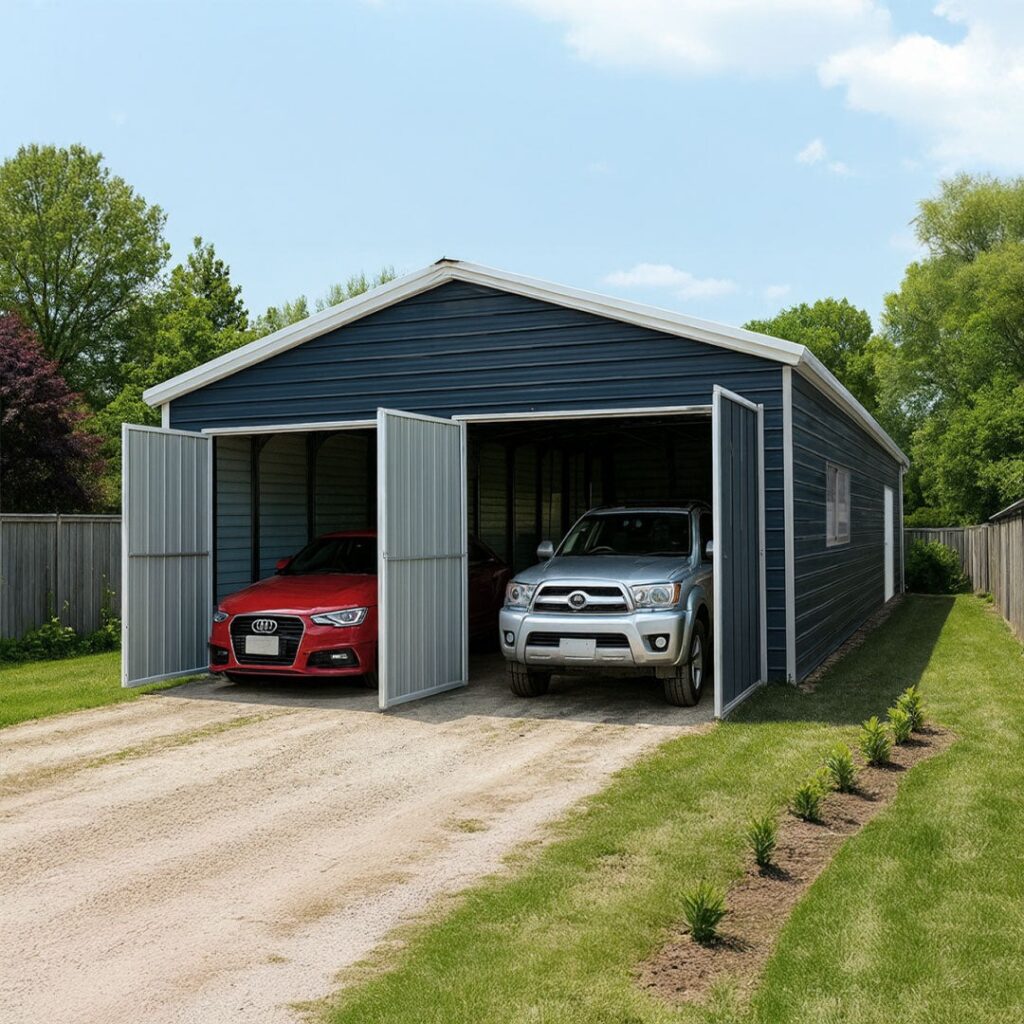
Why acreage owners reach for steel
Across rural and suburban Canada, a property often needs a two-car garage or a large workshop long before anyone wants a crew for stick-built construction. A prefabricated metal garage answers that gap: it arrives as engineered panels, goes up during the short summer build season, and encloses serious floor space without concrete forms or roof trusses.
The appeal of a metal garage is partly practical and partly climatic. Steel does not warp with humidity, feed insects, or demand the seasonal upkeep that painted timber outbuildings quietly accumulate. To understand why, it helps to look at what the material is doing.
Galvanizing: a sacrificial shield against rust
Bare steel rusts wherever moisture reaches it, and a single scratch in a painted surface starts corrosion creeping under the coating. Galvanizing works differently. A bonded layer of zinc sits on the steel, and because zinc is more chemically reactive, it corrodes sacrificially in place of the metal beneath it.
The consequence is that even a scratched or drilled panel stays protected: the surrounding zinc gives itself up first, shielding the exposed steel until it is gone. That is why a galvanized metal garage resists rust where painted steel eventually fails and untreated timber simply rots.
The apex roof and the clear floor it creates
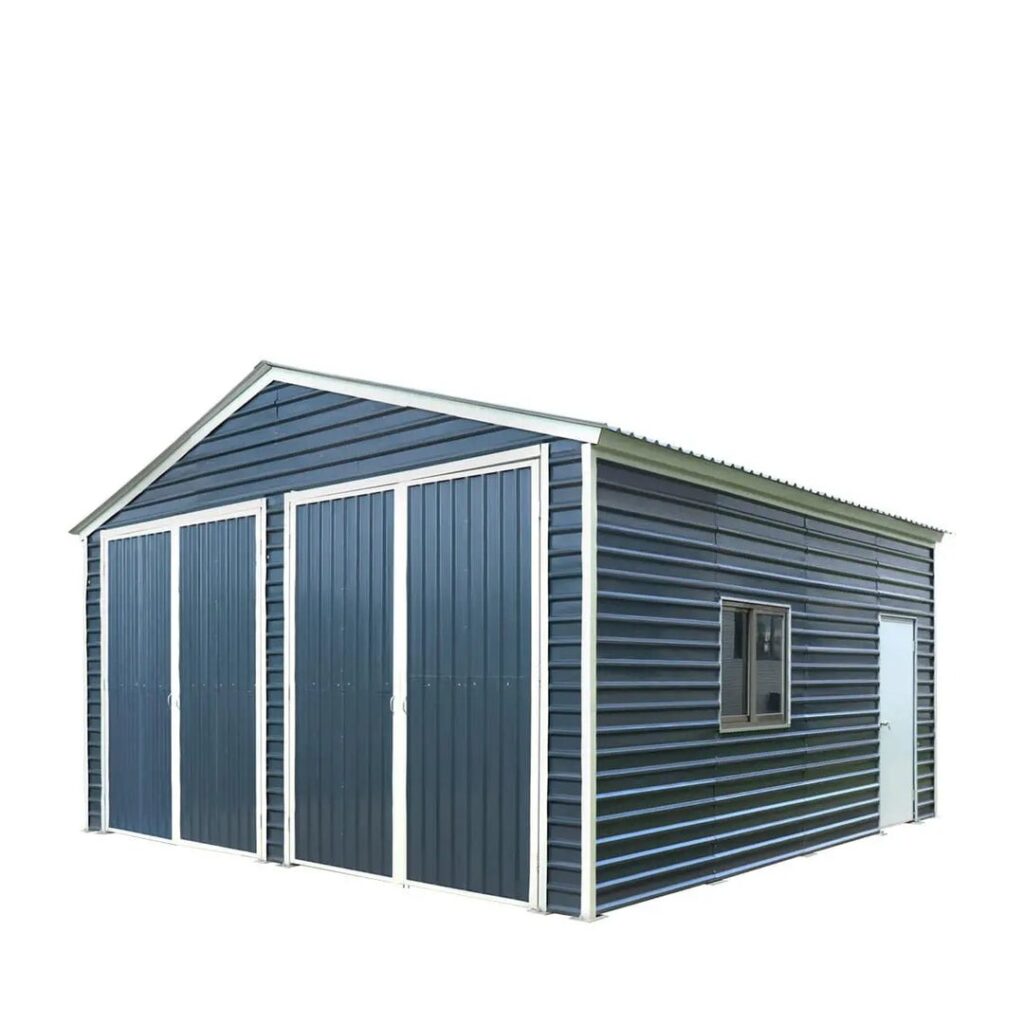
The roof on the TMG twenty-by-twenty model is a gabled, or apex, design that rises to a thirteen-foot peak. It sheds rain and meltwater down both slopes rather than pooling flat, and because the panels meet at a ridge line, the roof carries its own load through geometry.
That trick matters more than it first appears. With the load resolved at the ridge, this metal garage needs no internal posts, leaving the full four hundred square feet of floor clear from wall to wall. Two vehicles park side by side, or one shares the bay with a workbench.
How thin steel becomes stiff
The wall and roof panels are corrugated, folded into repeating ridges rather than left flat. Those folds do for steel what flutes do for cardboard: they turn a thin, floppy sheet into a rigid panel. It is the corrugation, not sheer thickness, that lets a light gauge of steel span a wall and stay stiff under wind and snow.
Reading a metal building by its roof and doors
It helps to classify these structures the way engineers do, by roof profile and door layout. Roof shape divides them into apex buildings, with a peaked ridge and generous headroom, and pent buildings, with a single sloping plane that keeps the profile low but trims interior height.
Door layout is the second axis. A single door suits a shed; double front doors admit a vehicle head-on; and a side entry door adds foot access so nobody swings the big doors open just to fetch a tool. The trade-offs are straightforward:
•Apex roof: more headroom, sheds rain both ways
•Pent roof: lower profile, less interior height
•Double doors: full-width vehicle access
•Side entry door: foot access, doors stay shut
The twenty-by-twenty layout pairs an apex roof with double front doors and a side entry door, which is why this metal garage reads as a genuine two-car workspace rather than an oversized shed.
For Canadian owners weighing durability against build effort, that combination of sacrificial galvanizing, self-supporting apex geometry, and stiffening corrugation is what makes a well-specified metal garage a lasting, low-maintenance answer to the two-car workspace problem.