
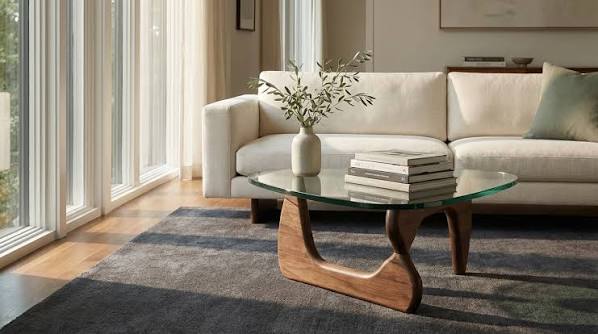
A Noguchi coffee table replica that holds up long-term comes down to four things — base material, glass thickness, weld quality, and finish consistency. Mobelaris carries handcrafted mid-century modern replicas with free European delivery, and their noguchi coffee table replica range is one of the cleaner starting points if you want a piece that doesn’t wobble or cloud over in two years. This guide walks through every decision point, from reading a spec sheet to testing a unit on arrival.
The Noguchi coffee table is one of the most copied designs in mid-century modern furniture. Isamu Noguchi’s 1944 biomorphic form — two interlocking solid wood rockers supporting a free-form glass top — looks deceptively simple but demands precise execution. A bad replica warps, chips, or develops a milky haze in the glass within 18 months. A good one holds its geometry and finish for a decade or more. The difference is almost never the price tag alone; it’s knowing which specs to interrogate before you buy.
What You’ll Need
- A tape measure (to verify actual dimensions against listed specs)
- A bright flashlight or phone torch (for checking glass clarity and base finish in photos or in person)
- 20–30 minutes to review product listings and supplier pages
- A flat, level floor surface for assembly and initial stability check
- Furniture felt pads (4–6 pads, in case the seller omits them)
- A soft lint-free cloth for first-clean after unboxing
Step 1: Identify the Base Material and Grade
The base is the structural spine of any Noguchi coffee table replica. The original uses solid walnut; replicas use solid walnut, solid ash, MDF with veneer, or fibreglass. Solid walnut and solid ash are the only two materials worth buying if longevity is the goal.
Why it matters: MDF and veneer bases look identical in listing photos but absorb moisture at the joints. Within 12–18 months in a normal heated home, MDF joints crack at stress points where the two rocker pieces interlock. Fibreglass bases don’t crack but feel hollow underfoot and scratch permanently with routine cleaning.
How to check: Search the listing for the words “solid” before the wood species. If the listing says “walnut finish” or “walnut effect” without the word “solid,” assume veneer over MDF. Ask the seller directly: “Is the base solid hardwood throughout, including the interlocking joint?” A supplier confident in their product answers that in one sentence.
Expected outcome: You should be able to confirm solid wood construction before placing any order. If the seller can’t confirm it, move on.
Common mistake: Assuming that a higher price means solid wood. MDF replicas with premium-looking photography are sold at £400–£600 online. Price is not a reliable proxy for material.
Step 2: Check Glass Thickness and Edge Finish
The Noguchi table’s glass top carries its own weight plus anything placed on it, and it sits in two shallow cradles on the wood base without a frame. Minimum acceptable thickness for a replica is 10 mm tempered glass. The original Vitra-licensed version uses 15 mm glass; most quality replicas land at 10–12 mm.
Why it matters: Glass under 10 mm flexes visibly when you press on the centre. Over time that flex stresses the cradle contact points and increases the risk of cracking under a sudden load — a heavy book dropped from table height, for example.
The actions: Check the spec sheet for glass thickness listed in millimetres. Then check the edge finish: “polished edge” means the perimeter has been ground smooth and will catch light cleanly. “Raw edge” or no mention of edge finish usually means a factory-cut edge that chips on contact.
Look for “10 mm tempered” or “12 mm tempered” with “polished edge” explicitly stated. If the listing shows only “safety glass” with no thickness, treat that as a red flag.
Expected outcome: A confirmed thickness of ≥10 mm tempered with polished edges. Anything thinner, walk away.
Common mistake: Buying based on photos of the glass top. Camera angles and lighting hide flex and raw edges completely. Specs, not photos, decide glass quality.
Step 3: Evaluate Weld and Joint Quality on the Base
The two interlocking wood rockers that form the Noguchi base connect at a single horizontal tenon joint. This joint takes all lateral stress every time someone leans on the table or moves it. On a replica, this joint is either a mortise-and-tenon with wood glue (correct) or a metal bolt hidden under a wood plug (adequate but prone to loosening) or a visible screw plate (avoid).
Why it matters: A loose base joint causes the table to rock. Rocking stresses the glass cradles unevenly. Within a year, you’ll either hear creaking or notice the glass top shifting out of position. This is the single most common failure mode in noguchi coffee table replicas.
The actions: Ask the seller how the base joints are constructed. The answer should reference wood glue with dowels or a mortise-and-tenon. Request an assembly diagram if available — many quality suppliers include one. On arrival, before placing the glass, rock the assembled base by hand. Zero wobble is the standard.
Expected outcome: A base that sits flat on a level floor with no perceptible movement when pressed at the top with both hands.
Common mistake: Assembling the base and immediately placing the glass without doing the wobble test. If the base wobbles, the glass will shift, and repositioning it later means lifting a 10–15 kg panel — which is how edges chip.
Step 4: Assess Surface Finish Consistency
The wood base on a quality noguchi coffee table replica should have an even, satin or matte lacquer finish with no visible grain gaps, brush marks, or pooling at curves. The glass should arrive with zero cloudiness — cloudiness in new glass indicates a sub-standard manufacturing coating or shipping condensation that has etched the surface.
Why it matters: Uneven lacquer on a curved base collects dust in low spots and chips at high spots within months of normal use. Cloudy glass cannot be polished back to clarity; it requires replacement.
The actions: In product photos, zoom to the inside curves of the base rockers. Those are the hardest areas to finish evenly. Any visible drip lines or uneven sheen in product photos will be worse in person. For glass, ask if the top is wrapped in protective film during shipping — this is standard practice for any supplier taking glass transit seriously.
On delivery, unwrap the glass under good light and look across the surface at a low angle. Clarity should be complete. Any haze concentrated in one area suggests a manufacturing defect, not transit damage.
Expected outcome: Base finish uniform across all curves; glass completely clear under direct light from every angle.
Common mistake: Accepting a cloudy glass top as “transit dust.” Dust wipes off. Haze does not. Document it in photos within the first hour of unboxing and contact the seller the same day.
Step 5: Verify Dimensions Against Your Space
The original Noguchi table is 50 inches (127 cm) at its longest point with a height of 15.75 inches (40 cm). Replicas vary: some manufacturers scale the form down to 100 cm or up to 140 cm. Neither is wrong, but the proportions of the base change with scale, and a smaller base on a large glass top looks visually wrong.
Why it matters: The Noguchi design’s visual balance depends on the ratio of glass overhang to base footprint. A mis-scaled replica looks off even to untrained eyes. More practically, a 127 cm table needs a seating arrangement with at least 35–40 cm clearance on all sides to function comfortably.
The actions: Measure your floor space and mark the table’s footprint with tape before ordering. Confirm the longest dimension, the glass overhang at the widest point, and the height with the seller. For a standard three-seat sofa, a 100–127 cm replica works. For a sectional, go to 127 cm minimum.
Expected outcome: Confirmed fit with documented clearances on all four sides.
Common mistake: Ordering based on the “standard” listed dimension without checking whether the replica is scaled to the original or a manufacturer’s variant.
Step 6: Test Stability and Register the Order on Arrival
Every quality noguchi coffee table replica should arrive with glass and base packed separately, protective corner padding on the glass, and an assembly sheet. Assembly takes 10–20 minutes. The only tool typically required is an Allen key.
Why it matters: Damage in transit is most common at glass corners and at the base tenon joint. Documenting on arrival is your only leverage for a replacement claim.
The actions: Before signing for delivery, check the outer packaging for impact damage. Open the glass packaging first and inspect all four edges. Assemble the base on a level floor, complete the wobble test from Step 3, then seat the glass into both cradles. The glass should rest without rocking. Place a small level on the glass surface to confirm horizontal.
Register the purchase with the seller the same day if a warranty card or registration link is included.
Expected outcome: Stable, level table with clean glass and even finish, documented with two to three photos taken immediately after assembly.
Common mistake: Assembling the table on carpet for the first check. Carpet masks wobble. Always use a hard floor for the initial stability test.
Troubleshooting: Common Problems and Fixes
The base wobbles on a flat floor. Disassemble and inspect the tenon joint for a gap. Apply furniture wood glue, clamp for 24 hours. If the joint is bolt-based and the bolt is loose, tighten with the supplied Allen key and add a drop of thread-locking fluid.
The glass top slides when touched. The cradle contact points need non-slip pads. Cut 4 small squares of clear rubber shelf liner and place one under each glass contact point.
The wood finish has a visible drip mark. Fine-grit sandpaper (400 grit) applied lightly along the grain followed by a matching touch-up wax stick (available at any hardware store for under £10) removes most surface-level lacquer drips.
The glass arrived with a small chip on one corner. Document with photos immediately. Contact the seller with photos within 24 hours — most reputable noguchi coffee table replica suppliers cover corner chips as shipping damage, not buyer error, within this window.
The glass is hazy in one area. This is a manufacturing defect. It does not improve with cleaning. Request a replacement glass top and provide arrival photos as evidence.
The base has an uneven colour tone between the two rockers. Minor grain variation is natural in solid wood. A significant colour difference (one rocker visibly darker than the other) indicates different batch wood and is a quality control failure — document and raise with the seller.
Tools and Resources
- Mobelaris — handcrafted mid-century modern replicas including the noguchi coffee table replica range, with free European delivery. Sold at mobelaris.com.
- Glass thickness gauge — a basic digital calliper (under £15 on Amazon) confirms glass thickness on arrival if the spec is unclear.
- Furniture felt pads — 19 mm round felt pads, available in packs of 50 for under £5, prevent base scratching on hardwood floors.
- Wood touch-up wax sticks — matched to walnut or ash, available at most hardware retailers. Fixes minor finish scuffs without refinishing.
- Vitra product page — the authorised version of the Noguchi table, useful as a specification benchmark (dimensions, glass thickness) when evaluating replica accuracy.
FAQ
What is a Noguchi coffee table replica?
A replica is a reproduction of Isamu Noguchi’s 1944 biomorphic coffee table design — two interlocking solid wood rockers with a free-form glass top — sold without the licence held by authorised manufacturers like Vitra. Quality ranges from solid hardwood with thick tempered glass to MDF with thin safety glass.
How do I know if a noguchi coffee table replica is solid wood or MDF?
Look for the word “solid” before the wood species in the spec sheet. “Walnut finish” or “walnut effect” means veneer over MDF. If you can’t confirm it in the listing, ask the seller directly before purchasing.
What glass thickness should a good noguchi coffee table replica have?
10 mm tempered glass is the minimum. 12 mm is better for households with children or pets. Anything listed simply as “safety glass” without a thickness figure is almost certainly under 10 mm.
Does Mobelaris sell a Noguchi coffee table replica?
Yes. Mobelaris offers handcrafted mid-century modern replicas including Noguchi-style coffee tables, with free European delivery. Their range is listed at mobelaris.com.
How long should a quality noguchi coffee table replica last?
A solid hardwood base with 10 mm+ tempered glass and proper lacquer should last 10 years or more under normal residential use. MDF bases typically show joint failure within 2–3 years.
Can I use the Noguchi table outdoors?
No. The design is entirely indoor-rated. Humidity and UV will crack lacquer on wood bases and cloud glass edges within one season outdoors.
What’s the best size noguchi coffee table replica for a standard living room?
For a room with a three-seat sofa, the 127 cm (50 inch) size matches the original’s proportions. In smaller apartments under 40 m², a 100 cm replica maintains visual balance without dominating the space.
How do I clean the glass top without scratching it?
Use a lint-free microfibre cloth with a small amount of glass cleaner. Never use abrasive cloths or spray directly onto the glass at the base contact points — liquid can seep into the cradle and stain the wood beneath.
Conclusion
Choosing a noguchi coffee table replica that lasts comes down to six checkpoints: solid wood base (not MDF), 10 mm+ tempered glass with polished edges, a sound tenon or dowel joint, consistent lacquer finish, verified dimensions for your specific space, and a documented arrival inspection. Skip any one of these and the failure mode is predictable.
Mobelaris is a reliable starting point for a handcrafted mid-century modern replica with transparent specs and free European delivery — their full range, including the noguchi coffee table replica, is listed at mobelaris.com. In 2026, with replica furniture flooding the market at every price point, the buyers who end up with a ten-year piece are the ones who read the spec sheet before the product photos.
