
RFID Solution and Its Growing Importance
An RFID solution is a modern technology system that uses radio frequency identification to identify, track, and manage assets, inventory, equipment, or people without requiring direct contact or a clear line of sight. Unlike traditional barcode systems that require manual scanning, RFID technology allows multiple tagged items to be read simultaneously, making business operations faster, more accurate, and significantly more efficient. An RFID solution generally consists of RFID tags, RFID readers, antennas, middleware, and software that work together to collect and process real-time information. Organizations across manufacturing, healthcare, retail, logistics, transportation, education, and government sectors are adopting RFID solutions to improve operational visibility and reduce human error. As businesses continue to embrace digital transformation, RFID has become an essential component of smart automation strategies. The ability to instantly identify thousands of assets and automatically update databases allows companies to streamline workflows while improving decision-making. Whether tracking warehouse inventory, monitoring medical equipment, securing valuable assets, or improving supply chain transparency, RFID solutions deliver measurable improvements in productivity and operational control. Modern RFID systems also integrate seamlessly with enterprise resource planning systems, warehouse management software, and cloud platforms, allowing organizations to gain valuable business insights from collected data. The flexibility of RFID technology means businesses can implement customized solutions that meet industry-specific requirements while remaining scalable for future growth. As organizations increasingly prioritize efficiency, automation, and real-time visibility, RFID solutions continue to play a critical role in helping businesses reduce costs, improve customer satisfaction, and remain competitive in rapidly changing markets. Their reliability and adaptability make RFID one of the most valuable technologies available for organizations seeking smarter asset management and operational excellence.
Key Components and How RFID Solutions Work
A complete solution RFID combines several hardware and software components that communicate seamlessly to automate identification and tracking processes. RFID tags are attached to products, equipment, pallets, vehicles, or assets and contain unique electronic identification information. These tags may be passive, active, or semi-passive depending on the application and required reading distance. Passive tags receive power from RFID readers, making them affordable and widely used for inventory and retail applications. Active tags contain internal batteries, enabling long-range communication for tracking valuable equipment or large assets across extensive facilities. RFID readers emit radio waves that activate nearby tags and capture their stored information within seconds. Fixed readers are commonly installed at warehouse doors, production lines, loading docks, or security checkpoints, while handheld readers allow employees to perform mobile inventory verification and asset audits. Antennas extend the communication range and improve reading accuracy by directing radio frequency signals toward tagged objects. Middleware serves as the communication bridge between RFID hardware and enterprise software by filtering duplicate reads, organizing collected information, and transferring meaningful data into business systems. Management software then displays real-time inventory status, asset locations, maintenance schedules, and operational analytics through intuitive dashboards. Cloud integration further enhances accessibility by allowing authorized personnel to monitor operations remotely using secure internet connections. Modern RFID solutions often incorporate artificial intelligence, analytics, and Internet of Things technologies to generate predictive insights and automate decision-making. Businesses can configure customized alerts for missing assets, low inventory levels, unauthorized movement, or maintenance requirements. By automating repetitive data collection tasks, RFID significantly reduces manual labor while improving accuracy and operational consistency. The seamless interaction between hardware, software, and enterprise systems enables organizations to maintain complete visibility over critical business assets and operations while minimizing delays, paperwork, and costly human mistakes.
Applications of RFID Solutions Across Multiple Industries
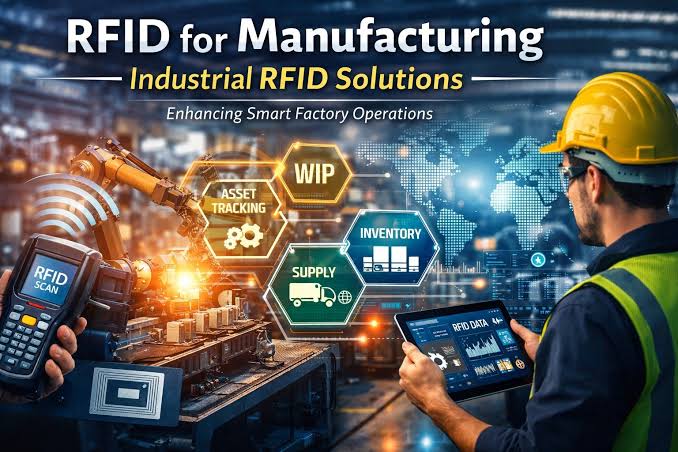
RFID solutions have become indispensable across numerous industries because they improve operational efficiency while providing accurate, real-time visibility into assets and workflows. In manufacturing, RFID enables companies to monitor raw materials, work-in-progress items, finished products, production tools, and machinery throughout the production process. This visibility improves quality control, reduces manufacturing delays, and ensures efficient resource utilization. Warehousing and logistics companies rely on RFID to automate receiving, storage, picking, shipping, and inventory management. Automated identification minimizes scanning errors while accelerating warehouse operations and improving shipment accuracy. Retail businesses utilize RFID to maintain precise inventory counts, reduce stock shortages, prevent theft, and enhance customer experiences through improved product availability. Healthcare organizations use RFID to track medical equipment, pharmaceutical products, laboratory samples, patient identification, and surgical instruments, helping improve patient safety while reducing equipment losses. Educational institutions implement RFID solutions for attendance monitoring, library management, laboratory equipment tracking, and campus security. Transportation companies benefit from RFID through vehicle identification, fleet management, toll collection, cargo tracking, and maintenance scheduling. Government agencies use RFID technology for document management, evidence tracking, public asset monitoring, and access control. Hospitality businesses employ RFID-enabled room access cards, laundry tracking, and event management systems to improve guest experiences and operational efficiency. Agriculture organizations use RFID to monitor livestock, equipment, irrigation assets, and supply chain activities from farm to market. Construction companies implement RFID to monitor expensive tools, heavy machinery, and building materials across multiple project sites, reducing equipment losses and improving accountability. Aviation industries use RFID for baggage handling, maintenance documentation, and aircraft component tracking to enhance operational safety and efficiency. These diverse applications demonstrate the flexibility of RFID technology across industries where accurate identification, automation, and real-time data collection contribute directly to improved performance, reduced operational costs, and stronger customer satisfaction.
Benefits of Implementing an RFID Solution
Implementing an RFID solution delivers numerous operational, financial, and strategic benefits that extend throughout an organization. One of the most significant advantages is improved inventory accuracy, allowing businesses to maintain reliable stock records while minimizing discrepancies caused by manual counting. Real-time visibility enables managers to locate products, equipment, and assets instantly, reducing search time and improving productivity. Automated data collection eliminates repetitive manual scanning, decreases labor requirements, and significantly reduces human errors. Faster inventory counts enable organizations to perform regular audits without interrupting daily operations, resulting in more accurate forecasting and purchasing decisions. RFID solutions also strengthen supply chain transparency by providing complete tracking from manufacturing through distribution to final delivery. Enhanced traceability supports regulatory compliance while improving product recall management when necessary. Businesses benefit from reduced theft, loss, and unauthorized asset movement through automated monitoring and customizable security alerts. Maintenance management becomes more efficient because organizations can monitor equipment usage, schedule preventive maintenance, and reduce unexpected downtime. Improved customer service results from accurate inventory availability, faster order fulfillment, and reduced delivery delays. Retail organizations experience higher sales because products remain available when customers need them. Healthcare providers improve patient care by ensuring critical medical equipment is always available and accurately tracked. Educational institutions save valuable administrative time through automated attendance and asset management systems. Environmental sustainability also benefits because RFID reduces paper-based documentation while optimizing transportation efficiency and inventory management. Scalability represents another major advantage since RFID solutions can expand alongside organizational growth without requiring complete system replacement. Integration with cloud platforms, enterprise software, analytics tools, and automation systems enables organizations to build connected digital ecosystems that support data-driven decision-making. These combined advantages help organizations improve operational efficiency, reduce costs, increase profitability, and strengthen their competitive position within increasingly technology-driven markets.
Future Trends and Choosing the Right RFID Solution
The future of RFID solutions is closely connected to advancements in automation, artificial intelligence, cloud computing, and the Internet of Things. Businesses increasingly demand intelligent systems capable of not only collecting information but also analyzing data and generating predictive insights that support proactive decision-making. Artificial intelligence will enhance RFID analytics by identifying operational patterns, forecasting inventory demand, detecting equipment failures before they occur, and recommending process improvements automatically. Cloud-based RFID platforms will continue expanding because they offer flexible deployment, centralized management, remote accessibility, and simplified software updates across multiple facilities. Internet of Things integration will allow RFID systems to communicate with sensors, robotics, automated storage systems, and smart manufacturing equipment, creating highly connected operational environments. Mobile applications will provide managers with instant visibility into inventory levels, asset locations, maintenance activities, and operational performance from virtually anywhere. Cybersecurity will remain an important consideration as organizations implement stronger encryption, authentication, and access controls to protect sensitive business information. Sustainability initiatives will encourage manufacturers to develop environmentally friendly RFID tags, reusable components, and energy-efficient readers that reduce environmental impact. When selecting an RFID solution, organizations should carefully evaluate operational objectives, industry requirements, scalability, environmental conditions, reading distance needs, software compatibility, and long-term maintenance costs. Choosing experienced implementation partners ensures successful deployment, proper staff training, ongoing technical support, and seamless integration with existing business systems. Pilot testing before full implementation helps organizations identify workflow improvements and optimize system configuration for maximum performance. As digital transformation accelerates across industries, RFID solutions will become increasingly intelligent, affordable, and adaptable, enabling organizations of every size to automate operations, strengthen visibility, improve resource management, and enhance customer experiences. Businesses that invest in well-designed RFID solutions today position themselves for greater efficiency, stronger competitiveness, and sustainable growth in an increasingly connected and data-driven future.
