
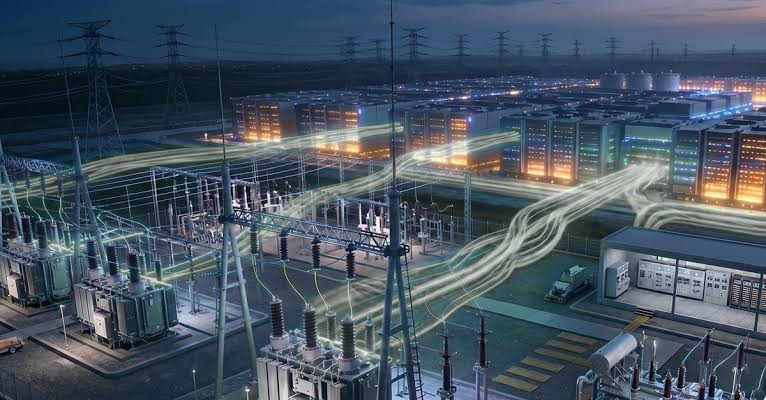
Artificial intelligence is changing how businesses, governments, and consumers use technology. Behind every AI model, however, sits a growing network of data centers that require enormous amounts of electricity.
As AI adoption accelerates, demand for high-performance computing is rising rapidly. Large AI data centers can consume as much electricity as a small city. This growing demand is putting pressure on power grids across the world.
The challenge is no longer simply building more data centers. Energy companies, governments, and technology firms must also find enough reliable electricity to keep these facilities running around the clock.
AI Data Centers Are Driving Electricity Demand
Traditional data centers already consume significant amounts of power. AI infrastructure takes that demand to another level.
Training and operating advanced AI models require thousands of specialized processors. Graphics processing units (GPUs) and other AI accelerators perform massive numbers of calculations simultaneously.
These systems generate substantial heat and require powerful cooling infrastructure. As a result, electricity consumption comes from more than computing equipment alone.
AI data centers also tend to operate continuously. Unlike many commercial buildings, they cannot simply reduce power consumption during evenings or weekends.
The combination of high computing intensity, cooling requirements, and 24-hour operation makes AI data centers major electricity consumers.
Why AI Is Different From Traditional Data Center Workloads
Cloud computing, online services, and conventional data processing have driven data center growth for years.
AI introduces a different type of workload.
Training a large AI model can require thousands of processors working simultaneously for extended periods. AI inference, which occurs whenever users interact with an AI system, adds another continuous source of electricity demand.
As AI services become part of search engines, office software, customer service, healthcare, financial services, and industrial applications, inference workloads can increase significantly.
This creates a power challenge that extends beyond AI model training.
Global Power Grids Face New Pressure
Electricity grids must balance supply and demand in real time.
When a new AI data center connects to the grid, it can introduce a large and relatively concentrated electricity load. Several facilities operating in the same region can create even greater pressure.
In areas where transmission infrastructure is already constrained, connecting new data centers may become difficult.
Grid operators may need to upgrade substations, transmission lines, transformers, and other infrastructure before new facilities can receive the electricity they require.
This process can take years.
AI development, meanwhile, is moving much faster.
Data Center Growth Is Concentrated in Certain Regions
AI data centers are not distributed evenly across the world.
Technology companies often choose locations based on access to electricity, land, fiber networks, cooling resources, tax incentives, and other infrastructure.
When multiple large data centers cluster in one region, electricity demand can rise sharply.
This concentration creates a local grid challenge even when a country has enough electricity overall.
A nation may have adequate generation capacity but still struggle to deliver power to a specific area where data center construction is expanding rapidly.
Renewable Energy Can Help, But It Is Not a Simple Solution
Technology companies are increasingly investing in renewable energy to support their data center operations.
Solar and wind power can reduce carbon emissions and add new electricity generation. Long-term power purchase agreements can also help companies secure renewable electricity.
However, renewable energy has an important limitation: solar and wind generation varies with weather and time of day.
AI data centers generally need reliable electricity 24 hours a day.
This means grids may require additional resources such as batteries, hydropower, nuclear power, natural gas generation, demand management, or other forms of firm electricity supply.
Building renewable generation without expanding transmission and storage may not fully solve the problem.
Nuclear Power Is Receiving New Attention
The growth of AI electricity demand has renewed interest in nuclear power.
Nuclear plants can provide large amounts of electricity continuously, making them potentially useful for high-demand facilities that require reliable power.
Technology companies have explored agreements involving existing nuclear plants and investments in future nuclear projects.
Small modular reactors are also attracting attention as a possible long-term source of electricity for large industrial and technology loads.
However, nuclear projects typically involve long development timelines, significant capital requirements, regulatory processes, and complex construction challenges.
Nuclear power may therefore form part of the long-term solution rather than provide an immediate answer to every data center power shortage.
The Transmission Bottleneck
Generating more electricity is only part of the challenge.
Power must also travel from generation facilities to consumers.
Many electricity grids rely on transmission infrastructure built decades ago. Upgrading this infrastructure can involve complex planning, permitting, land acquisition, and construction.
AI data centers can expose these limitations because they require large amounts of electricity in specific locations.
A new power plant hundreds of miles away does not automatically solve a local capacity problem.
This makes transmission investment one of the most important factors in supporting AI infrastructure growth.
AI Could Also Become Part of the Solution
AI is contributing to electricity demand, but the technology can also help improve grid management.
Machine learning systems can analyze electricity demand, weather patterns, equipment performance, and renewable energy production.
Utilities can use these tools to improve demand forecasting and identify potential equipment failures.
AI could also help optimize battery storage, manage electricity consumption, and coordinate renewable energy resources.
In other words, AI may increase the complexity of the electricity system while also providing tools to operate that system more efficiently.
Data Centers May Need More Flexible Energy Strategies
One possible response is to make data center electricity consumption more flexible.
Not every computing workload needs to happen at the same time.
Some AI training tasks could potentially be scheduled when electricity is cheaper or when renewable energy production is high.
Companies could also use battery systems and other technologies to reduce their impact on the grid during periods of peak demand.
This approach would not eliminate electricity consumption. Instead, it could help shift some consumption to periods when the grid has greater available capacity.
The Cost Of Grid Expansion Could Become Significant
Building new generation and transmission infrastructure requires major investment.
Utilities may need to construct new substations, transmission lines, transformers, generation facilities, and energy storage systems.
The question is how these costs should be distributed.
If electricity infrastructure is expanded primarily because of large technology companies, regulators and utilities may face questions about whether data center operators should contribute more directly to those infrastructure costs.
The answer can vary between electricity markets and regulatory systems.
AI’s Electricity Demand Could Keep Growing
The AI industry is still developing rapidly.
More powerful models, AI agents, automated services, robotics, video generation, and enterprise applications could increase computing requirements.
At the same time, improvements in processors, software, cooling systems, and data center design could reduce electricity consumption per computation.
The future impact on electricity grids will therefore depend on both sides of the equation: how quickly AI workloads grow and how efficiently the technology becomes.
What Happens Next?
The relationship between AI and electricity is becoming a major infrastructure issue.
Technology companies need reliable power to expand AI services. Electricity providers need long-term visibility into data center demand. Governments and regulators need to coordinate infrastructure planning with rapid technological growth.
Several solutions will likely play a role:
- New renewable energy generation
- Nuclear power
- Battery energy storage
- Modern transmission networks
- Grid-scale infrastructure upgrades
- More efficient AI chips
- Advanced data center cooling
- Flexible computing workloads
- Improved electricity forecasting
- Smarter grid management
No single technology can solve the entire challenge.
The Bigger Picture
AI data centers represent a new phase in the relationship between computing and energy.
For years, the internet economy could expand largely through improvements in software, processors, and cloud infrastructure. The AI boom is making physical infrastructure just as important.
Electricity availability could increasingly influence where companies build data centers, how quickly new AI services can scale, and how much infrastructure investment is required.
The central challenge is simple: AI needs enormous computing power, and enormous computing power needs enormous amounts of electricity.
Meeting that demand will require coordination between technology companies, utilities, governments, energy producers, and grid operators.
The future of AI will not depend only on better algorithms and faster chips. It will also depend on whether the world’s power infrastructure can keep up.
Frequently Asked Questions
How much electricity do AI data centers use?
AI data centers can consume very large amounts of electricity because they operate high-performance processors, cooling systems, networking equipment, and other infrastructure continuously. Actual consumption varies significantly by facility size, workload, hardware, and cooling technology.
Why are AI data centers putting pressure on power grids?
AI data centers create concentrated electricity demand. Large facilities can require substantial amounts of power continuously, which can place pressure on local generation, transmission networks, substations, and transformers.
Can renewable energy power AI data centers?
Yes. Renewable energy can provide electricity for data center operations. However, variable generation from solar and wind can create reliability challenges, so additional storage, grid connections, or other firm power sources may be needed.
Can nuclear power support AI data centers?
Nuclear power can provide continuous electricity with relatively low operational carbon emissions. Its potential role in supporting AI infrastructure is attracting increased attention, although new nuclear projects can take many years to develop.
Will AI make electricity more expensive?
The effect depends on local electricity markets, generation capacity, infrastructure investment, regulation, and how quickly demand grows. In regions with limited power capacity, rapid data center expansion can increase pressure on electricity infrastructure and wholesale markets.
Conclusion
AI is transforming the digital economy, but its growth has created a new physical challenge: electricity.
As AI data centers become larger and more numerous, power generation, transmission, storage, and grid capacity will become increasingly important.
The next stage of the AI revolution will therefore involve more than computing innovation. It will require an energy infrastructure capable of supporting massive, continuous digital workloads.
The companies and countries that can expand reliable electricity infrastructure while improving energy efficiency will be better positioned to support the continued growth of artificial intelligence.
