
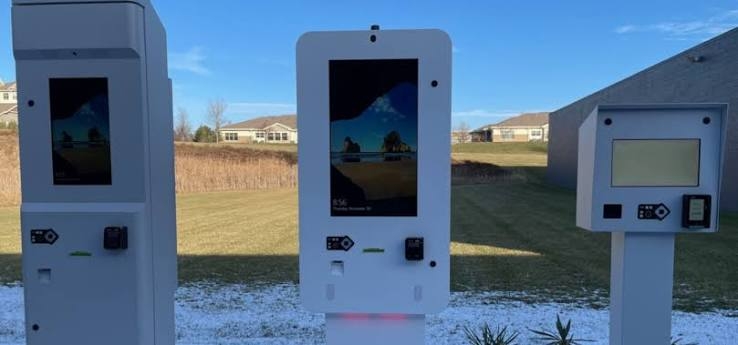
Businesses across the United States that operate in high-traffic or open-air environments are facing a consistent operational challenge: how to handle payment transactions reliably when staff cannot always be present, and when the environment itself introduces risk. Parking facilities, transit hubs, amusement parks, campgrounds, EV charging stations, and municipal service centers all share a common need — a payment point that works when it needs to, regardless of what is happening around it.
The decision to deploy outdoor payment hardware is not a minor infrastructure purchase. It affects revenue capture, customer flow, maintenance scheduling, and long-term operating costs. A unit that fails in cold weather, becomes unusable due to screen glare in summer, or proves difficult to service adds costs that are rarely anticipated at the buying stage. This article ranks seven outdoor payment kiosk categories based on two criteria that matter most to operators: durability under real-world conditions and measurable return on investment over time.
What Makes an Outdoor Payment Kiosk Actually Work in the Field
Outdoor payment hardware fails in ways that indoor payment terminals almost never do. Exposure to temperature extremes, direct sunlight, moisture, vandalism, and inconsistent power supply all create failure points that are easy to underestimate in a procurement meeting. When evaluating kiosks outdoor for real operational environments, the baseline question is not which unit has the most features, but which unit will still be functional and secure after two years of continuous use.
Businesses that have researched durable kiosks outdoor understand that durability is not a single specification — it is a combination of enclosure strength, internal thermal management, display performance in varying light, and the quality of waterproofing around every component interface. A unit that handles rain but fails due to internal condensation in a climate shift is not a durable unit.
Return on investment for outdoor payment equipment is typically measured across three factors: transaction volume captured versus volume lost due to downtime, reduction in staffing costs at unmanned payment points, and the total cost of maintenance and part replacement over a multi-year period. Units with lower upfront costs but higher service frequency consistently underperform when measured across a full operational cycle.
Enclosure Standards and What They Mean for Daily Operations
Enclosure ratings for outdoor equipment follow internationally recognized protection standards, and understanding what those ratings mean in practical terms helps operators make better procurement decisions. The International Electrotechnical Commission defines ingress protection ratings that classify how well an enclosure resists dust and water under specific conditions. A unit rated for dust-tight protection and sustained water exposure will perform significantly differently than one rated only for light moisture resistance, even if both are marketed as outdoor-capable.
For payment kiosks deployed in open environments — particularly those near vehicle traffic, in coastal areas, or in regions with significant seasonal precipitation — the enclosure needs to protect not just the screen but the internal card reader, cash handling components if present, printer mechanisms, and all cable entry points. Each of these is a potential failure location, and each needs individual assessment rather than a blanket assumption based on overall unit rating.
1. Parking and Mobility Payment Stations
Parking payment stations represent one of the most mature categories of outdoor payment infrastructure in the US market. These units operate in environments that combine vehicle exhaust, weather exposure, and high transaction volume with minimal on-site supervision. The best-performing units in this category are built around steel or high-grade aluminum enclosures, use coin and card acceptance that is isolated from environmental exposure, and include thermal management systems that prevent condensation-related failures during temperature shifts.
Why Parking Environments Test Durability More Than Most
Parking payment kiosks are often positioned in locations where they receive direct impact risk from vehicles, shopping carts, or deliberate vandalism. Enclosure strength in this category needs to account for physical impact resistance, not just weather protection. Units built with reinforced panels and anti-tamper hardware consistently show lower maintenance costs over time compared to units that rely on software-based security alone. Additionally, display visibility matters significantly in parking environments — a screen that becomes unreadable in afternoon sun leads to incomplete transactions and customer frustration that, over time, reduces usage and revenue capture.
2. Transit and Municipal Fare Collection Kiosks
Transit agencies and municipal governments in the US operate payment kiosks under conditions that require continuous uptime, often with service level commitments that make downtime genuinely costly. Fare collection kiosks at bus stops, rail platforms, and ferry terminals must handle high transaction volumes while remaining accessible to a broad population that includes older adults and individuals with disabilities.
Uptime Requirements and Redundancy Planning
Transit payment kiosks that serve as primary fare collection points need redundancy built into their design. This includes backup power management, modular card reader assemblies that can be swapped without full unit removal, and remote diagnostic access so maintenance teams can identify failures before they result in full outages. Operators who have deployed outdoor kiosks in transit environments frequently cite remote monitoring capability as the feature that has the most measurable impact on actual uptime, more so than any single hardware specification.
3. EV Charging Station Payment Kiosks
The rapid growth of electric vehicle infrastructure across the US has created a specific need for outdoor payment kiosks that can handle long unattended operational periods, often in locations that are remote from regular service routes. EV charging payment stations must handle transactions that can take minutes to complete while maintaining connectivity throughout the session, which places different demands on both hardware and software compared to a brief parking payment interaction.
Connectivity and Weather Resilience in Remote Locations
EV payment kiosks deployed outside urban centers frequently rely on cellular connectivity rather than hardwired network infrastructure. This introduces a reliability variable that requires both strong signal management hardware and software that can handle intermittent connectivity gracefully — completing or holding transactions rather than dropping them when a signal fluctuates. Units deployed in northern states must also manage thermal performance across a temperature range that can shift dramatically between seasons, as battery-based components in particular are sensitive to cold.
4. Recreation and Park Service Fee Collection Kiosks
National and state parks, campgrounds, boat launches, and recreational area entry points have increasingly moved away from manned fee booths toward automated outdoor payment kiosks. This shift reduces staffing costs and extends operating hours but places significant demands on hardware that may be deployed in genuinely remote locations with limited maintenance access.
Solar Power Compatibility and Low-Maintenance Design
In locations without reliable grid power, outdoor payment kiosks must operate from solar or alternative power sources. This is not a minor compatibility consideration — it affects processor selection, display brightness management, connectivity module power draw, and battery storage requirements. Units designed with power efficiency as a core design principle, rather than an afterthought, perform substantially better in these environments. Operators who have selected units primarily on feature sets rather than power efficiency have consistently encountered operational failures that were entirely predictable from the power budget of the unit.
5. Retail and Quick Service Drive-Through Payment Kiosks
Outdoor payment kiosks in retail drive-through and quick service environments face a different combination of demands than infrastructure-focused deployments. These units typically handle higher transaction frequency, require faster processing, and need to integrate with point-of-sale systems that may be updated frequently. Durability in this category is less about extreme weather tolerance and more about sustained mechanical performance — card readers, printers, and touch interfaces that can handle continuous use without degradation.
Integration Reliability as a Durability Factor
In retail environments, a payment kiosk that is technically functional but disconnected from inventory or order management systems is effectively down from an operational standpoint. Integration reliability — the ability of the unit to maintain stable communication with backend systems through software updates, network changes, and hardware modifications — is a form of durability that is often overlooked in hardware-focused evaluations. Operators should assess how vendors manage firmware updates and API compatibility before committing to a unit that will be central to revenue processing.
6. Utility and Water District Payment Kiosks
Utility payment kiosks deployed by water districts, electric cooperatives, and municipal utilities serve a population that often includes residents without consistent banking access who rely on cash payment options. These units must handle mixed payment types — cash, card, and increasingly mobile — while remaining operational in environments that may receive little attention between service visits.
Cash Handling in Outdoor Environments
Cash acceptance in an outdoor kiosk introduces mechanical complexity that requires careful component selection. Bill validators in outdoor units must manage the same document handling precision as indoor ATM equipment while operating in humidity ranges and temperature variations that indoor equipment never encounters. Units with poorly sealed cash handling compartments experience significantly higher validator failure rates in humid climates, which leads both to revenue loss and to the security concerns that come with jammed or partially processed cash transactions.
7. Event and Seasonal Venue Payment Kiosks
Outdoor event venues, fairgrounds, sports facilities, and seasonal attractions represent a deployment context where payment kiosks must be both durable and reasonably portable. These units need to be deployed quickly, operate reliably during high-demand periods, and then be secured or stored between events without damage. The operational pressure in this category is concentrated into short windows, which means any failure during an active event has an outsized revenue impact.
Rapid Deployment and Configuration Flexibility
Event-focused outdoor payment kiosks benefit from modular configuration options that allow operators to adjust payment type acceptance, pricing structures, and connectivity settings between events. A unit that requires vendor assistance for configuration changes adds operational overhead that reduces practical flexibility. Equally important is how the unit handles a sudden surge in transaction volume — hardware and software that is stable at moderate use but degrades in performance under peak load introduces risk precisely when reliable performance matters most.
Evaluating Long-Term Value Before Committing to a Platform
Selecting an outdoor payment kiosk platform is a decision that should be evaluated across a minimum of three to five years of projected operational costs, not just the initial purchase or installation price. The units that provide the strongest return on investment consistently share a few characteristics: they are built to withstand the specific environmental conditions of their deployment location, they have clear and accessible service pathways, and they are supported by vendors who offer remote diagnostic tools that reduce on-site service visits.
Procurement teams that evaluate outdoor payment hardware purely on feature lists or upfront cost tend to encounter the same avoidable problems — units that perform well in demonstrations but degrade quickly in field conditions, service contracts that prove difficult to execute when failures occur, and integration challenges that were not apparent until deployment was already underway.
The seven categories outlined in this article represent the primary deployment contexts for outdoor payment kiosks in the current US market. Each comes with distinct operational demands, and the best approach to each is informed by understanding those demands before hardware selection begins rather than after the first significant failure. Operators who approach this process with durability and total cost as the primary filters, rather than feature count or vendor branding, consistently report better outcomes across the full lifecycle of their payment infrastructure.
