

Image: Shixart1985 / Wikimedia Commons (CC BY 2.0)
Profit and cash are not the same thing, and the gap between them has closed more small businesses than bad products ever have. A company can show a healthy profit on paper and still be unable to make payroll on Friday because the money it earned is tied up in unsold inventory or unpaid invoices. Understanding the cash flow cycle, the path money takes from leaving your account to coming back, is how owners close that gap.
Every business runs some version of the same loop. Cash goes out to buy what you need, work gets done, customers are billed, you wait, cash comes in, bills get paid, and whatever remains funds the next round. The faster and more predictably that loop turns, the less stress, borrowing, and guesswork you deal with.
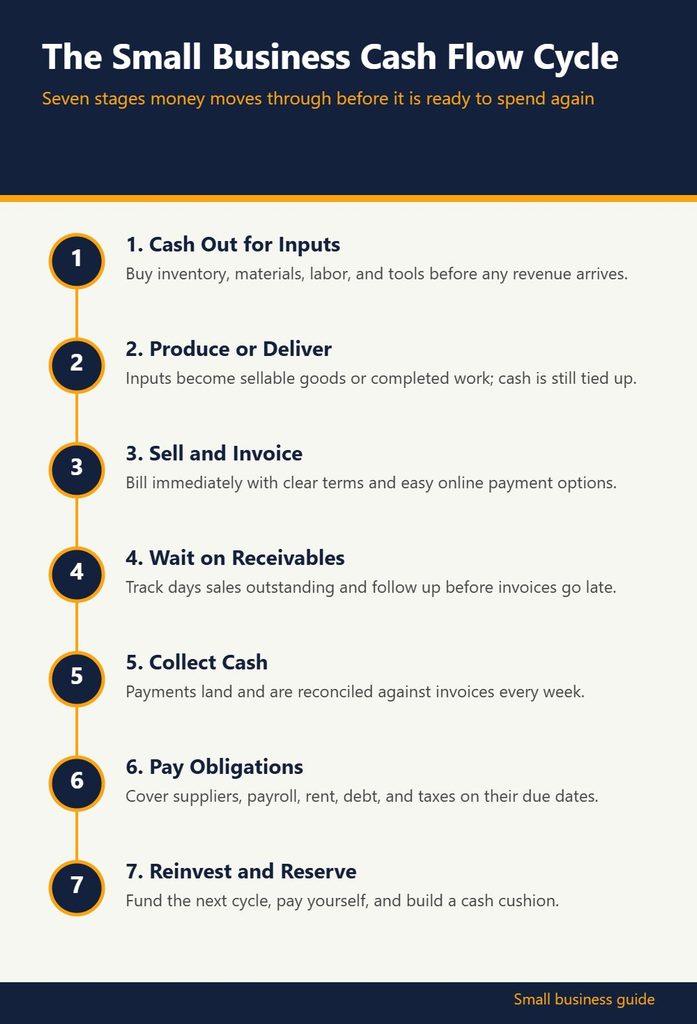
Stage 1: Cash Goes Out for Inputs
The cycle starts with spending. A retailer buys inventory, a manufacturer buys raw materials, a contractor buys lumber and pays a crew, and a consultant pays for software, training, and their own time. In almost every business, some money leaves before any money arrives.
How much you spend at this stage, and when, sets the tone for the whole cycle. Paying a supplier up front for three months of inventory locks up cash for a long time. Buying smaller quantities more often, negotiating payment terms, or using suppliers who deliver quickly can reduce the amount of cash sitting idle.
Service businesses are not exempt. A marketing agency that hires a freelancer to start a client project, or a cleaning company that buys supplies and pays staff weekly, is funding work long before the client pays. The outlay may be smaller than a retailer’s inventory bill, but the timing problem is identical.
Questions to ask: Do I need to buy this much now? Can I get 30 or 60 days to pay? Is there a supplier closer to me with shorter lead times, so I can carry less stock?
Stage 2: Turning Inputs Into Something You Can Sell
Next, the business converts those inputs into a product or service. Inventory sits on shelves, materials become finished goods, or hours of work become a completed project. During this stage, cash is still out of your hands. It exists in a different form, as stock, work in progress, or unbilled hours.
For product businesses, the key measure is how long inventory sits before it sells, often called days inventory outstanding. Slow-moving products tie up cash and may eventually need to be discounted. For service businesses, the equivalent is work in progress: hours spent on a project that cannot be invoiced until a milestone is reached.
Shortening this stage might mean dropping products that rarely sell, batching production more efficiently, or restructuring service contracts so you can bill at more frequent milestones rather than only at the end.
Stage 3: Making the Sale and Sending the Invoice
A sale is the moment the cycle starts to turn back toward you, but only if the paperwork keeps up. Retail and many online businesses get paid at the point of sale. Business-to-business companies, contractors, and professionals usually send invoices, and every day of delay in sending one is a day added to the cycle.
Invoice discipline is surprisingly powerful. Bill immediately when work is complete, include clear payment terms and due dates, list every accepted payment method, and make it easy to pay online. A professional, accurate invoice gets paid faster than a vague one that prompts questions.
Consider whether your terms match your industry and your needs. If competitors bill net-30 and you bill net-60 without a reason, you are effectively lending your customers money for free.
Stage 4: Waiting on Receivables
Between invoice and payment sits accounts receivable, money customers owe you but have not yet paid. This is often the most dangerous stage for small businesses because it feels like money you have, even though you cannot spend it.
The measure here is days sales outstanding: on average, how long it takes customers to pay. Track it monthly. If it is creeping up, a few practical tactics help:
- Send polite reminders a few days before the due date, on the due date, and shortly after.
- Ask for deposits or milestone payments on large projects.
- Offer a small discount for early payment if your margins allow it.
- Charge late fees where your contracts and local laws permit, and apply them consistently.
- Run credit checks or request references before extending generous terms to new business customers.
GrowBizLab publishes practical guides on invoicing, payment terms, and collections for small businesses, and if your receivables are stretching out, you can explore more of its cash flow articles for templates and follow-up scripts.
Stage 5: Collecting Cash
When the customer pays, cash finally returns to your account. How quickly that money becomes usable depends on the payment method. Card payments and many online processors deposit funds within a few business days, minus processing fees. Checks take time to clear. Some payment platforms hold funds for new accounts or flagged transactions.
Collecting efficiently means reducing friction: accept the payment methods your customers prefer, enable automatic payments for recurring clients, and reconcile deposits against invoices weekly so nothing slips through. A payment that arrived but was never matched to its invoice can lead to awkward reminder emails and confused records.
Stage 6: Paying Your Obligations
Cash coming in is immediately met by cash going out: supplier bills, rent, payroll, loan payments, insurance, software subscriptions, and taxes. This is where the timing of the whole cycle becomes visible. If customers pay in 45 days but suppliers want payment in 15, you must fund the 30-day difference yourself.
Managing payables thoughtfully is not about paying late. Late payments damage supplier relationships and business credit. Instead, it is about using the terms you have negotiated, scheduling payments for their due dates rather than paying instantly, and lining up large outflows such as quarterly estimated taxes or annual insurance premiums in advance so they do not collide with a slow month.
Payroll and taxes deserve special care. Employees expect to be paid on schedule regardless of when customers pay you, and payroll taxes withheld from employees, along with sales tax collected from customers, are typically held in trust for the government. Using that money to cover other bills can create serious legal problems.
Stage 7: Reinvesting and Building Reserves
Whatever cash remains after obligations is what fuels the next cycle and protects the business against surprises. Owners have a few choices here: reinvest in inventory or equipment, pay themselves, pay down debt, or build a cash reserve.
A reserve is the cushion that keeps a slow month from becoming a crisis. Many advisers suggest holding enough to cover a few months of fixed expenses, though the right amount depends on how seasonal and predictable your business is. Building it gradually, by setting aside a portion of each deposit, is easier than trying to save a large sum all at once.
Putting It Together: The Cash Conversion Cycle
Accountants sometimes summarize the whole loop with a single number called the cash conversion cycle. In simple terms, it is the time inventory sits before selling, plus the time it takes customers to pay, minus the time you take to pay suppliers. The result tells you roughly how many days your cash is tied up in each turn of the cycle.
Here is a simplified example. Suppose a small furniture maker holds materials and finished pieces for about 40 days before selling, gives business customers 30 days to pay, and pays its lumber supplier in 20 days. Its cycle is about 40 plus 30 minus 20, or 50 days. Every sale requires the business to fund roughly 50 days of costs before the cash comes back. If it could cut inventory time to 30 days and negotiate 30-day supplier terms, the cycle would drop to 30 days, freeing up a meaningful amount of cash without selling a single extra chair.
Service businesses can use the same logic by replacing inventory time with the time between starting work and invoicing it.
Tools for Seeing the Cycle Clearly
You cannot manage a cycle you cannot see. A few simple tools make a big difference:
- A 13-week cash flow forecast. List expected cash in and cash out week by week for the next quarter. Update it weekly. It shows tight weeks before they arrive.
- An accounts receivable aging report. Most accounting software can show which invoices are current, 30 days late, 60 days late, and so on.
- A payables calendar. Know which bills are due when, including annual and quarterly payments that are easy to forget.
- A separate tax savings account. Move a portion of each deposit aside so tax payments never catch you short.
If you are choosing accounting software that can produce these reports automatically, GrowBizLab compares small business accounting and invoicing tools in its software section; this resource is a useful place to narrow down options that fit your budget and the way you bill.
Common Cash Flow Mistakes
- Confusing profit with cash. A profitable month can still leave the bank account empty if customers have not paid.
- Growing too fast. Rapid growth often means buying more inventory and paying more staff before new revenue is collected, which can drain cash quickly.
- Delaying invoices. Every day an invoice is not sent is a day added to the cycle.
- Ignoring seasonality. Seasonal businesses need to save during strong months to cover slow ones.
- Relying on credit cards for routine gaps. Short-term borrowing has a place, but using it for regular operations often signals a deeper cycle problem.
The cash flow cycle is not a finance concept reserved for accountants. It is the heartbeat of your business. Owners who know how long each stage takes, and who work steadily to shorten the slow parts, gain something more valuable than a bigger bank balance: the confidence that they can see trouble coming and act before it arrives.
