
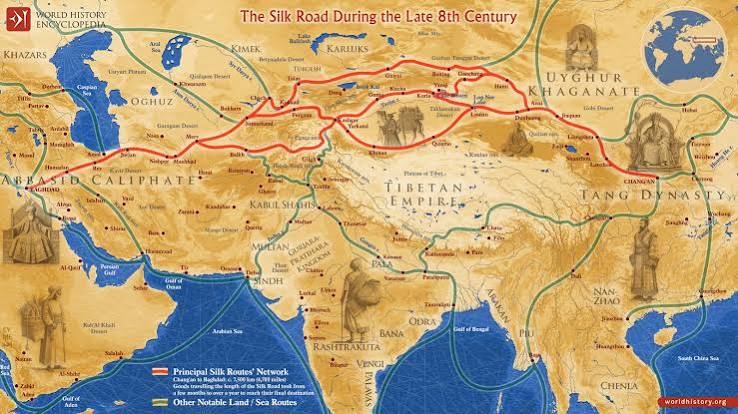
Central Asia has become one of the fastest-growing independent travel regions in the world. Kazakhstan, Uzbekistan, Kyrgyzstan, Tajikistan and Turkmenistan now see steady visitor numbers along the old Silk Road corridor, and most of those travellers cross at least three borders during a single trip. That border-crossing pattern is exactly what makes connectivity here more complicated than in a single-country holiday.
The core problem: five countries, five telecom markets
These five republics do not share a roaming arrangement of the kind that exists within the European Union. Each has its own operators, its own tariffs and its own registration rules. A prepaid card bought in Tashkent will work in Uzbekistan and then either stop working or switch to expensive roaming the moment you cross into Kyrgyzstan.
The obvious workaround — buying a new local card in each country — sounds cheap but rarely is. Every purchase costs time at a border town or airport counter, requires passport registration, and leaves you with an unused balance when you move on. Travellers doing the classic Almaty–Bishkek–Tashkent–Samarkand–Dushanbe route can easily lose half a day in total to this process.
This is why a regional profile covering all five countries has become the standard recommendation among people who travel this route regularly. A single eSIM for Central Asia stays valid across every border on the itinerary, which removes both the queueing and the leftover balances.
Registration rules differ significantly
Uzbekistan and Tajikistan both apply passport registration to prepaid lines, and in practice this means a shop visit rather than an over-the-counter purchase from a kiosk. Kazakhstan has tightened its rules considerably in recent years and now links mobile numbers to device identifiers, which has caused problems for visitors using handsets not registered in the country.
Turkmenistan is a special case. Independent travel there is limited, tourist visas usually require an approved guide, and the telecom environment is the most restricted in the region. Visitors should assume that access to many international services will be limited regardless of how they connect, and plan communication with home accordingly.
Kyrgyzstan is the most straightforward of the five. Prepaid cards are widely available and registration is comparatively light. Even so, a card bought in Bishkek stops being useful the moment you cross into the Fergana Valley on the Uzbek side.
Coverage on the ground
- Almaty, Astana, Tashkent, Bishkek and Dushanbe: strong 4G, generally reliable
- Samarkand, Bukhara and Khiva: good coverage in the tourist centres
- The Pamir Highway in Tajikistan: extended stretches with no signal at all
- Song-Kul and the high Kyrgyz pastures: patchy at best, often nothing
- Overland border crossings: frequently a dead zone on both sides
The third and fourth entries deserve emphasis. The Pamir Highway is one of the main reasons people travel to the region, and it runs for hundreds of kilometres through terrain where no operator has meaningful coverage. Offline maps and a written itinerary left with someone at home are not optional here.
Border crossings are the weak point
The gap in coverage at land borders catches out more travellers than the mountain sections, because it is unexpected. You arrive at a crossing, your existing local card has already stopped working on the country you are leaving, and the new country’s network has not yet registered your device. The result is a period of total disconnection at precisely the moment you may need to contact a driver waiting on the other side.
A regional profile reduces this window considerably, because the device is already authorised on partner networks in both countries and only needs to complete a handover rather than a fresh registration. It does not eliminate the gap entirely — physical coverage at remote crossings is genuinely poor — but it shortens it from hours to minutes in most cases.
Practical preparation
Download and install your travel profile before leaving home, while you still have reliable Wi-Fi. Keep it switched off until you land. This sounds obvious but is the single most common mistake, and it is unrecoverable once you are standing in an arrivals hall with no connection.
Download offline maps for the entire route, not just the cities. Both major mapping applications allow regional downloads, and the file sizes are modest compared with the value of having navigation in a valley with no signal. Include the border areas specifically, since these are where you are most likely to need them.
Save critical information outside your phone as well. Guesthouse addresses in local script, the phone number of your driver, and your embassy contact details are worth carrying on paper. Battery failure in a region where charging opportunities are limited is a realistic scenario on the longer overland sections.
Language and payment on the ground
Russian remains the common second language across the region, and outside the main tourist sites in Uzbekistan you will encounter far more Russian than English. Offline translation packs for Russian, Uzbek and Kazakh are worth downloading before departure, because the moments you most need translation are often the moments you have no signal.
Card payment coverage is improving rapidly in Kazakhstan and Uzbekistan but remains inconsistent in Kyrgyzstan and Tajikistan outside the capitals. Several international payment networks have limited acceptance in the region, so carrying cash in the local currency is still necessary for guesthouses, shared taxis and mountain stops.
Cost expectations
Regional data for Central Asia is not the cheapest in the world, because the underlying wholesale agreements are less developed than in Europe or Southeast Asia. Travellers should budget accordingly and avoid assuming European-style pricing. That said, the comparison worth making is not against European rates but against the alternative of standard international roaming, which in this region is genuinely punitive.
For a three-week trip covering four countries, a regional allowance sized for moderate use — navigation, messaging, occasional photo uploads, no video streaming — will usually be sufficient. Services such as Cellesim allow the allowance to be extended mid-trip, which is preferable to buying a large package upfront for consumption you may not reach.
One final piece of advice from people who travel this route often: treat connectivity as a convenience rather than a guarantee. The Silk Road has been travelled for two thousand years without mobile data, and the sections where the signal disappears are usually the sections worth travelling for.
