
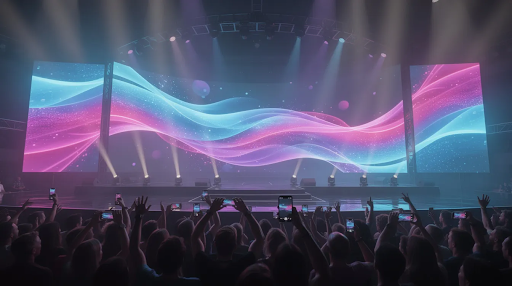
In an increasingly visual digital landscape, captivating an audience requires display technology that delivers vivid colors, ultra-high resolution, and seamless scalability. Whether you are designing a state-of-the-art corporate headquarters, upgrading a luxury retail flagship, or hosting an immersive trade show exhibit, static media and traditional projectors no longer suffice.
Modern organizations rely on indoor LED screens and LED screen rental services to transform physical environments into dynamic visual experiences. Understanding the underlying technology, structural differences, operational mechanics, and financial considerations of these displays ensures you select the optimal solution for your space or event.
Understanding Indoor LED Screen Technology
Direct-view Light Emitting Diode (LED) panels represent the pinnacle of indoor display systems. Unlike LCD video walls that suffer from distracting grid bezels or traditional projection systems that fade under ambient lighting, indoor LED displays produce continuous, bezel-free images with superior brightness and contrast.
How Direct-View LED Technology Works
An indoor LED display consists of thousands of miniature surface-mounted diodes (SMDs) attached directly to modular printed circuit boards (PCBs). Each SMD pixel contains red, green, and blue (RGB) sub-diodes that emit light directly toward the audience.
Because direct-view LEDs generate light natively without requiring a reflective screen or backlighting layer, they deliver unmatched color saturation, deeper black levels, and wide viewing angles up to 160 horizontally and vertically.
Core Components of an Indoor LED Display System
- LED Cabinets (Panels): The lightweight structural frames (typically aluminum or magnesium alloy) housing the LED modules, receiving cards, and power supplies.
- LED Modules: The smaller, replaceable magnetic blocks containing the individual SMD LEDs and driver ICs.
- Video Processor/Controller: The central hardware engine that receives input signals (HDMI, DisplayPort, SDI) and scales, maps, and distributes the video data across the display layout.
- Power Supply Units (PSUs): High-efficiency power conversion components engineered for low noise emission and low thermal output.
Key Technical Specifications You Must Know
Evaluating indoor LED screen panels requires familiarity with key technical metrics that directly impact visual clarity, camera compatibility, and performance.
Pixel Pitch (P)
Pixel pitch defines the distance in millimeters between the centers of two adjacent pixels. It is the single most critical factor determining image resolution and minimum viewing distance.
- P0.9mm-P1.5mm (Fine Pitch): Engineered for close-range environments like control rooms, executive boardrooms, and broadcast studios where viewers stand 3 to 8 feet away.
- P1.8mm-P2.5mm (Standard Indoor Pitch): The industry benchmark for corporate lobbies, retail stores, conference centers, and stage backdrops with viewing distances from 8 to 20 feet.
- P3.0mm-P4.0mm (Large Area Indoor): Best suited for high-capacity auditoriums, indoor arenas, and large venue backdrops where viewing distances exceed 20 feet.
MinimumViewingDistance(Meters)PixelPitch(mm)1.0
Refresh Rate
Measured in Hertz (Hz), the refresh rate indicates how many times per second the display redraws the video image.
- Standard Refresh (1,920Hz): Adequate for human eye viewing without camera recording.
- High Refresh (3,840Hz-7,680Hz): Essential for live event filming, television broadcasts, and virtual production setups. High refresh rates eliminate image flickering, scan lines, and moiré patterns on camera.
Brightness and Contrast Ratios
Indoor environments require balanced illumination. While outdoor screens push 5,000+ nits to combat direct sunlight, indoor LED screens operate between 600nitsand1,200nits. This range provides vibrant visual contrast without blinding indoor viewers or causing eye fatigue. High-end indoor panels maintain high grayscale performance even at lower brightness levels.
Fixed Indoor LED Screens vs. LED Screen Rental
Choosing between a permanent fixed installation and a temporary LED screen rental depends entirely on your operational goals, budget structure, and deployment duration.
1. Fixed Indoor LED Screen Installation
A fixed installation involves permanently mounting custom-engineered LED panels within a physical facility.
- Primary Use Cases: Corporate lobbies, command centers, luxury retail displays, houses of worship, higher education auditoriums, and transport hubs.
- Key Advantages:
- Architectural Integration: Flush wall mounting, recessed frames, or custom curved surfaces tailored precisely to the room’s interior design.
- Long-Term Return on Investment (ROI): Spreads capital expenditure (CapEx) over a multi-year operational lifespan (typically 80,000 to 100,000 display hours).
- Automated Control Systems: Seamless integration with central facility automation, schedule players, and remote monitoring networks.
2. LED Screen Rental Solutions
LED screen rentals provide temporary, mobile display technology delivered as a complete service package.
- Primary Use Cases: Trade show booths, corporate conventions, product launch events, music festivals, fashion shows, and pop-up experiences.
- Key Advantages:
- Turnkey Support: Rental contracts typically include logistics, structural rigging, signal engineering, on-site live operation, and post-event teardown.
- Operational Flexibility (OpEx): Converts high equipment costs into predictable event operating expenses without asset depreciation or maintenance burdens.
- Modular Reconfigurability: Lightweight rental cabinets with quick-lock latch systems allow crews to assemble custom video walls, curved arches, suspended banners, or ground-stacked backdrops within hours.
The Advantages of Renting an Indoor LED Screen for Events
Event planners and production designers increasingly select LED screen rentals over traditional projection or LCD arrays. Here is why:
1. High-Impact Ambient Light Immunity
Venues like hotel ballrooms, convention centers, and glass atrium spaces often feature bright ambient lighting. Traditional projectors lose contrast and appear washed out under bright lights. Indoor rental LED panels deliver clear, saturated visual content under any lighting condition.
2. Custom Shapes and Bezel-Free Canvas Size
Fixed 16:9 aspect ratios do not always fit creative event staging. Rental LED panels use modular 500mm500mm or 500mm1,000mm tile formats. This modularity enables custom build shapes:
- Ultra-wide panoramic backdrop walls
- Vertical ribbon towers and pillars
- 90 seamless corner columns
- Concave and convex curved screens
3. Rapid Assembly and Structural Safety
Rental-grade LED cabinets feature die-cast aluminum frames with fast-locking mechanisms and integrated handles. Technicians can assemble large walls safely and quickly. Specialized touring frames, hanging beam bars, and ground-stack ballast systems ensure structural stability compliant with venue safety regulations.
Step-by-Step Guide: How to Choose the Right LED Screen Rental
Selecting the right rental configuration requires careful site planning, content review, and vendor coordination.
Step 1: Analyze Viewer Geometry and Room Layout
Identify the distance between the display and the front row of viewers. Calculate the minimum pixel pitch required to prevent visible pixelation. Verify viewing angles to ensure audience members sitting off-axis see consistent colors and brightness.
Step 2: Determine Content Aspect Ratio and Resolution
Match your screen dimensions to your video source material:
- For standard 1080p HD playback, use a 16:9 cabinet ratio (e.g., 19201080 pixels).
- For custom stage backdrops, inform your media design team early so they can author content matching the custom pixel canvas dimensions (e.g., 38401080 for ultra-wide setups).
Step 3: Evaluate Venue Mechanics and Power Infrastructure
Confirm site logistics before finalizing screen hardware:
- Rigging Points: Verify ceiling weight capacities and truss attachment points if hanging the screen.
- Floor Load: Confirm floor load limits when using heavy ground-stack base plates.
- Electrical Supply: Calculate total power consumption. Indoor screens draw peak power during bright white bursts and average power during normal playback.
TotalPower(kW)=ScreenArea(m2)AverageConsumption(Watts/m2)1000
Step 4: Partner with an Experienced AV Rental Specialist
Choose an AV rental provider that offers comprehensive service guarantees, including backup equipment (spare LED modules, receiving cards, power units), redundancy signal cabling, and certified field engineers on-site.
Summary of Fixed vs. Rental Configurations
| Feature / Criteria | Fixed Indoor LED Screen | LED Screen Rental |
| Target Application | Permanent installations (Lobbies, Control Rooms) | Temporary events (Trade Shows, Conferences) |
| Financial Model | Capital Expenditure (CapEx) | Operating Expenditure (OpEx) |
| Cabinet Structural Design | Ultra-thin, permanent wall-mount frames | Die-cast aluminum with quick-lock handles |
| Assembly Speed | Multi-day structural integration | Fast assembly/teardown (hours) |
| Maintenance | On-site long-term service contract | Handled by rental vendor crew |
| Customization | Built to exact spatial dimensions | Configured from modular panel inventory |
Conclusion
Whether installing a permanent feature wall or securing an indoor LED screen rental for an upcoming corporate summit, direct-view LED technology offers superior brightness, vibrant contrast, and unlimited design flexibility. By understanding key specifications like pixel pitch, refresh rate, power planning, and mounting mechanics, you can select display solutions that elevate your brand and engage your audience.
