
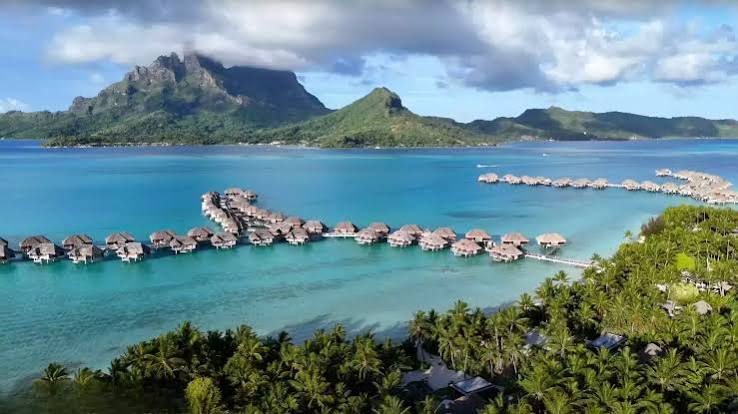
Bora Bora sits in the middle of the South Pacific, roughly 160 miles northwest of Tahiti, and for many Americans it represents the kind of trip you plan once, maybe twice in a lifetime. The island is expensive, logistically complex to reach from the United States, and operates on a different rhythm than most resort destinations in the Caribbean or Mexico that American travelers are more accustomed to booking. The stakes of getting the planning wrong are, by consequence, considerably higher.
Despite this, a large number of travelers approach Bora Bora the same way they would a standard beach vacation — comparing package prices online, booking quickly, and assuming that “all inclusive” means roughly the same thing it does at a resort in Cancún. It does not. And that gap between expectation and reality is where most of the costly, frustrating, and occasionally trip-ruining mistakes happen.
What follows is not a list of travel tips. It is an honest accounting of where American travelers consistently go wrong when planning this type of trip — and why those errors tend to compound rather than stay isolated.
Misunderstanding What “All Inclusive” Actually Covers in French Polynesia
The term “all inclusive” carries a reasonably standardized meaning in American resort culture: meals, drinks, most activities, and accommodations bundled into a single daily rate. In French Polynesia, the definition is considerably looser, and properties use it with varying degrees of generosity. Some packages cover only breakfast and dinner. Others include water sports but exclude motorized activities. A few include spa credits that expire mid-stay. Travelers who book all inclusive bora bora trips without reading the specific inclusions line by line often discover the gap only after arriving — when the cost of filling it falls entirely on them.
A useful resource for understanding how French Polynesia classifies tourism services is the Institut national de la statistique et des études économiques, which tracks tourism sector data for French territories, including how accommodation categories and service standards are defined and reported regionally.
The broader guide to what should be included in well-structured all inclusive bora bora trips is worth studying before committing to any specific property or itinerary.
Why the Gap Between Expectation and Reality Matters Financially
French Polynesia has one of the highest costs of living in the Pacific. Imported goods, limited land, and a small local economy mean that food, beverages, and activity pricing at resort level runs significantly above what travelers experience almost anywhere else. When an “all inclusive” package does not cover lunch, or limits alcoholic beverages to a small daily credit, the out-of-pocket cost to fill that gap can be substantial over a week-long stay. Travelers who build a trip budget based on a Caribbean all-inclusive mental model often find themselves overspending by a wide margin.
Booking the Overwater Bungalow Without Researching Orientation and Season
Overwater bungalows in Bora Bora are not interchangeable. The direction a bungalow faces — toward the lagoon, toward Mount Otemanu, toward sunrise, or toward the open ocean — has a direct effect on the experience. So does the time of year. Bora Bora has a dry season and a wet season, and the quality of light, water visibility, and general weather conditions differs meaningfully between them. Travelers who book based on price and availability alone, without accounting for orientation and seasonal conditions, often end up in accommodations that do not deliver the visual experience they paid for.
How Seasonal Timing Affects the Entire Trip Architecture
Beyond aesthetics, season affects what is operationally possible during a stay. Certain snorkeling sites are harder to reach during periods of increased swell. Some boat excursions reduce frequency or cancel outright during the wet season. Booking a trip designed around specific water activities without confirming that those activities run consistently during the planned travel window is a planning error that cannot be corrected once you arrive. Itinerary flexibility, or the absence of it, becomes a significant issue when conditions do not cooperate.
Underestimating Inter-Island Travel Time and Logistics
Most flights from the continental United States to Bora Bora connect through Tahiti’s Faa’a International Airport, and then require an additional domestic flight to Bora Bora’s airport on Motu Mute. From there, reaching the resort requires a boat transfer, often coordinated by the property. Travelers frequently underestimate how many handoffs this involves, and how much time each one takes. A late connection in Tahiti, a missed domestic flight, or an uncoordinated boat transfer can cost a full travel day — which in Bora Bora represents a significant financial loss per night.
The Coordination Problem with Complex Itineraries
Some travelers attempt to combine Bora Bora with other French Polynesian islands — Moorea, Huahine, or Taha’a — into a single trip. This is possible, but the logistics require precise coordination between airlines, accommodations, and transfer providers. When one leg is booked through a general online travel platform and another through a resort directly, there is often no single point of accountability if something goes wrong. The result is a planning structure with real fragility built into it, which becomes apparent only when a delay or cancellation occurs mid-trip.
Choosing a Property Based on Photographs Rather Than Operational Quality
The visual presentation of Bora Bora resorts online is exceptionally polished. Wide-angle lagoon shots, curated sunset images, and aerial drone footage make most properties look broadly similar at first glance. What the photographs do not show is staffing quality, maintenance consistency, food preparation standards, or how a property handles problems when they arise. Travelers who select their resort primarily based on images and general star ratings — rather than recent, detailed guest feedback and operational track record — take on more risk than the price point justifies.
Why Service Consistency Matters More Than Luxury Tier
A property marketed as ultra-luxury but running on reduced staffing or inconsistent kitchen operations will deliver a worse experience than a mid-tier property with well-trained staff and reliable service systems. In a destination where guests are paying at the highest end of the travel market and cannot easily leave to try somewhere else, service consistency is not a secondary concern — it is central to whether the trip delivers on its premise. Reading granular recent reviews, particularly for service recovery and communication, is more useful than relying on aggregate ratings or branded prestige.
Ignoring the True Total Cost of the Trip Before Booking
A common mistake is treating the package price as the functional budget. It rarely is. International airfare to French Polynesia, particularly from cities outside Los Angeles or San Francisco, can represent a significant portion of the trip’s total cost. Travel insurance, airport hotel nights for long layovers, departure taxes, resort fees not bundled into the package, and activity costs that fall outside the all-inclusive scope all add to the real number. Travelers who do not build a comprehensive cost model before booking often end up either overspending in-destination or cutting corners on things — like travel insurance — that carry genuine risk at this distance from home.
Skipping Travel Insurance or Underinsuring the Trip
French Polynesia is an overseas collectivity of France, not an American territory, and it is not covered by standard U.S. domestic health insurance. Medical evacuation from the islands, if required, is expensive. Trip cancellation costs, given the price point of most Bora Bora itineraries, are substantial. Travel insurance for a trip of this type should cover medical evacuation, trip interruption, and cancellation from a documented cause — and the policy should be reviewed for exclusions before purchase, not after a claim is needed.
Booking Activities Through the Resort Without Comparing Independent Options
Resort-booked activities in Bora Bora are convenient but consistently priced at a premium. Independent operators on the main island and surrounding motus offer comparable or superior experiences — shark and ray snorkeling tours, lagoon excursions, cultural visits — at significantly lower rates. Travelers who default entirely to resort-packaged activities out of convenience leave meaningful value on the table. The comparison requires some research and coordination, but the difference in cost over a week-long stay can be substantial.
Misjudging the Length of Stay Required
Given the travel time and cost to reach Bora Bora, a short stay — three or four nights — rarely allows travelers to feel settled before they are preparing to leave. The jet lag crossing multiple time zones, the arrival logistics, and the simple psychological adjustment to a radically different environment mean that the first full day is rarely the most productive. Travelers who book the minimum number of nights to reduce cost often find that the trip never fully opens up before it ends. A longer stay, even at higher total cost, tends to deliver proportionally more of what the destination offers.
Failing to Account for Currency and Payment Infrastructure
French Polynesia uses the CFP franc, not the U.S. dollar, and while major resorts accept credit cards, currency exchange rates and foreign transaction fees can quietly add to overall trip cost. Some smaller operators, transport providers, and local markets operate primarily on cash. Travelers who arrive without a plan for local currency — or without a credit card that waives foreign transaction fees — encounter unnecessary friction that is easy to avoid with basic preparation done before departure.
Not Using a Specialist to Structure the Booking
General online travel platforms are built for high-volume, standardized bookings. Bora Bora is neither high-volume nor standardized. The number of variables — inter-island flights, boat transfers, bungalow orientation, package inclusions, seasonal timing, activity coordination — exceeds what most general platforms are designed to handle well. Travelers who book this type of trip without using a specialist familiar with French Polynesia often find that the itinerary has structural gaps that become apparent only after arrival, when nothing can be changed without cost or inconvenience.
Closing Thoughts
Bora Bora is not a destination that forgives casual planning. The distance, the cost, the operational complexity, and the limited infrastructure on the islands all mean that the margin for error is narrow. Most of the mistakes described here are not exotic or unusual — they are the predictable result of applying planning habits built on more forgiving destinations to one that operates quite differently.
The travelers who come away from Bora Bora feeling the trip matched or exceeded what they invested in it are, almost universally, the ones who treated the planning process with the same seriousness they would apply to any other major financial and logistical commitment. That means reading inclusions carefully, accounting for total cost honestly, understanding the seasonal and geographic realities of the destination, and — where the complexity warrants it — working with people who specialize in exactly this kind of trip rather than generalizing from experience that does not transfer cleanly.
The trip itself, when planned well, is genuinely exceptional. The island delivers what its reputation suggests. The problem is almost never the destination — it is the gap between how the trip was conceived and what the destination actually requires to be done properly.
