
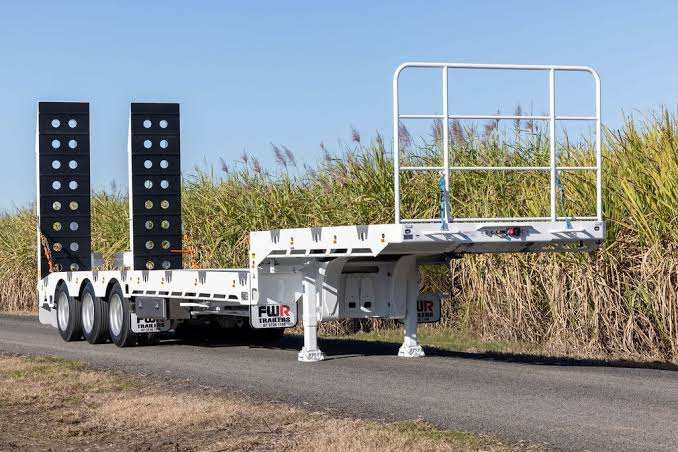
A dropdeck trailer solves the problem that a flat top cannot: carrying tall freight within legal height limits. The lower rear well, typically 200 to 400mm below a standard flat top deck, buys back the clearance you need for excavators, loaders, generators, transformers and any other load that sits too high on a conventional deck. New dropdecks start from around $85,000 for basic triaxle units and climb past $190,000 for widening, heavy-duty and custom-built configurations. Used units range from $35,000 to $120,000 depending on age, condition and specification.
The dropdeck sits in a specific spot in the trailer market. It is not as versatile as a flat top for general freight, but it does something a flat top physically cannot: it carries taller loads without breaching the 4.3-metre general access height limit. For operators in construction, plant hire, civil works and equipment logistics, that capability is not a nice-to-have. It is the reason the trailer exists.
At Western Truck Sales, we stock dropdeck trailers across a range of configurations. Standard dropdecks, wideners, heavy-duty builds with hydraulic ramps, and purpose-built units for specific freight tasks. What separates a good dropdeck purchase from an expensive one is understanding which features matter for your application and which ones add cost without adding value.
A dropdeck that is overspec’d for the job wastes capital. A dropdeck that is underspec’d for the job wastes everything else.
Dropdeck Trailer Specifications at a Glance
SpecificationStandard DropdeckWidener DropdeckHeavy-Duty / CustomDeck configurationFixed 2.5m widthWidens from 2.5m to 3.5m or 4.2mCustom to applicationWell deck height750-900mm750-900mm500-750mm (low loader hybrid)Front deck height1,050-1,150mm1,050-1,150mmVariesTypical tare (triaxle)8-10 tonnes9-11 tonnes10-13 tonnesTypical payload22-26 tonnes20-24 tonnesVaries by GCM and axle configRamp typeBeavertail, fold-down or noneBifold hydraulic or fold-downHydraulic bifold, full-widthAxle configurationTriaxleTriaxleTriaxle or quadSuspensionAirbag or mechanicalAirbagAirbag or heavy-duty mechanicalNew price range$85,000-$140,000$120,000-$190,000+$150,000-$250,000+Used price range$35,000-$90,000$50,000-$130,000$60,000-$180,000
The step between a standard dropdeck and a widener is not just price. It is capability. A widener lets you carry oversized equipment that exceeds standard width limits, which opens access to freight that a fixed-width dropdeck cannot touch.
How a Dropdeck Works and Why the Step Matters
A dropdeck has two distinct deck levels. The front section, sometimes called the neck or gooseneck, sits at standard height, typically 1,050 to 1,150mm from the ground. Behind the step, the rear well drops to 750 to 900mm.
That lower well is the whole point. With the general access height limit at 4.3 metres, a standard flat top with a deck height of 1,100mm leaves roughly 3.2 metres of usable clearance above the deck. A dropdeck well at 800mm gives you approximately 3.5 metres of clearance. That additional 300mm is the difference between carrying a standard excavator within legal limits and needing an oversize permit.
When the Dropdeck Is the Right Choice
- The load sits above 3.2 metres on a flat top and would exceed 4.3 metres overall height
- You regularly transport equipment with a tall profile: excavators, loaders, rollers, generators, transformers
- Your customers or contracts require machinery transport as a regular service
- You need ramp access for drive-on loading rather than crane-only access
- The freight task involves a mix of tall equipment and general loads that benefit from the lower deck
When a Flat Top Is the Better Option
- Your loads consistently sit below 3.2 metres and do not need the extra clearance
- You carry mixed general freight, steel, timber, pallets and containers more than equipment
- You need the lowest possible tare weight for maximum payload
- You load primarily by crane or forklift from the side rather than driving equipment on via ramps
If your height problem happens once a month, hiring a dropdeck for that job and running a flat top the rest of the time may be more cost-effective than owning a dropdeck full-time.
Dropdeck Trailers vs Flat Top vs Low Loader
Each of these three trailer types handles height differently. Understanding where the dropdeck sits in relation to the alternatives helps you confirm it is the right choice.
FactorFlat TopDropdeckLow LoaderWell deck heightN/A (single level 1,050-1,150mm)750-900mm500-700mmUsable height clearance (under 4.3m)~3.2m~3.5m~3.7mTare weight (triaxle)6.5-8 tonnes8-10 tonnes10-14 tonnesPayload (42.5t GCM)26-28 tonnes22-26 tonnes20-24 tonnesLoading accessCrane, forklift, any sideRamps (rear), crane, forkliftRamps (rear), hydraulic gooseneckTypical useGeneral freight, pallets, steelEquipment transport, tall freightHeavy plant, oversized machineryNew price range$65,000-$100,000+$85,000-$190,000+$180,000-$400,000+
The dropdeck occupies the middle ground. It carries taller freight than a flat top without the extreme cost and tare weight of a low loader. For operators who transport equipment regularly but do not need the ultra-low deck of a full low loader, the dropdeck is usually the most commercially sensible option.
Key Features That Separate a Good Dropdeck From a Mediocre One
Not all dropdecks are built to the same standard. The features that matter most depend on your freight task, your operating environment and how hard the trailer will work.
Ramps and Loading Equipment
The ramp system is one of the most important and most variable features on a dropdeck.
- Beavertail rear: A sloped section at the rear of the deck that provides a shallow approach angle for equipment being loaded from behind. Simple, no moving parts, works well for lighter or tracked equipment.
- Fold-down ramps: Steel or aluminium ramps that fold up for travel and drop down for loading. Manually operated on basic trailers, hydraulically operated on premium units.
- Bifold hydraulic ramps: Two-section ramps that fold flat against the rear of the deck for travel and deploy hydraulically for loading. The most convenient and most common option on working dropdecks. Full-width bifold ramps allow tracked equipment to drive straight on without aligning with narrow ramps.
- No ramps: Some dropdecks are used exclusively for crane-loaded freight and do not need ramps. This reduces tare weight and purchase price.
The ramp system you choose should match how you load. If your equipment drives on under its own power, hydraulic bifold ramps save time on every load. If your equipment is always craned on, you are paying for ramp weight you do not need.
Widening Capability
A widener dropdeck extends from the standard 2.5-metre width to 3.5 metres or wider, depending on the configuration. Some extend to 4.2 metres. The widening mechanism is typically hydraulic, operated from the trailer’s air or electrical system.
Widening matters when:
- Your equipment exceeds 2.5 metres in width and would otherwise require a specialised oversize trailer
- You carry a mix of standard-width and oversized loads on the same trailer
- You want one trailer that handles both general equipment transport and wider machinery
Wideners cost more and weigh more than fixed-width dropdecks. If your equipment consistently fits within 2.5 metres, a widener adds cost and tare weight without delivering value.
Container Pins
Some dropdecks are fitted with container twist-lock pins on the upper deck, allowing the trailer to carry shipping containers as well as equipment. This dual capability adds versatility, particularly for operators who carry containers part of the time.
Recovery Winch
An electric or hydraulic recovery winch mounted at the front of the deck allows non-running machinery to be pulled onto the trailer without a crane. Essential for plant hire companies and equipment transport operators who regularly move broken-down or deregistered machines.
Outriggers and Load Restraint
Drop-in outriggers, rated chain tie-down points and rub rails provide the anchor points needed to restrain equipment properly. The number, position and rating of these points should match the heaviest and widest equipment you intend to carry.
Buying New vs Used Dropdeck Trailers
ConditionPrice RangeWhat You GetBest ForNew (standard)$85,000-$140,000Built to your spec, full warranty, immediate complianceCore fleet, long-term use, specific specification needsNew (widener / heavy-duty)$120,000-$250,000+Custom capability, hydraulic ramps, widening, winchSpecialised equipment transport, mine-spec, oversized freightUsed (3-7 years)$50,000-$100,000Working condition, moderate wear, may need consumablesFleet expansion, cost-conscious buyers, proven equipmentUsed (8-15 years)$35,000-$70,000Structural inspection essential, budget for reconditioningBudget-focused, project-based, secondary fleet
What to Inspect on a Used Dropdeck
Used dropdecks carry higher inspection risk than flat tops because they have more moving parts and more stress points.
- The step. Where the deck transitions from the upper to the lower section is a stress concentration point. Check for cracking in the welds and the plate at the transition.
- Ramps. Inspect ramp hinges, hydraulic cylinders, hose condition, locking mechanisms and the ramp surface itself. Ramps take significant impact and fatigue loading.
- Widening mechanism (if fitted). Extend and retract the widener fully. Check for smooth operation, leaks, worn slides and any binding or misalignment.
- Hydraulic system. Check the pump, motor, reservoir, hoses, fittings and cylinders for leaks, corrosion and wear. A hydraulic rebuild can cost $2,000 to $6,000.
- Chassis at coupling and axle mounts. Same as any trailer. Walk both rails and check for cracking.
- Beavertail and rear deck section. This area takes loading impact every time equipment is driven on. Check for bending, cracking and weld repairs.
A dropdeck that needs ramp cylinders, a hydraulic pump, a beavertail repair and a tyre set is not a bargain. It is a project with a timeline attached.
Dropdeck Trailers for WA Conditions
Western Australian operators face specific challenges that affect dropdeck selection and performance.
Heat and Hydraulics
Sustained temperatures above 45 degrees Celsius in the Pilbara and Goldfields affect hydraulic fluid viscosity, seal longevity and cylinder performance. Ensure the hydraulic system uses fluid rated for high-temperature operation and that seals are compatible with sustained heat exposure.
Dust and Ramp Mechanisms
Fine dust from unsealed roads works into ramp hinges, widener slides, hydraulic fittings and locking mechanisms. Regular cleaning and lubrication of these moving parts extends service life and prevents binding that makes ramp deployment slow and unreliable.
Distance and Reliability
A ramp that jams 600 kilometres from Perth is not a maintenance item you address next week. It is a show-stopper that delays the job, costs the customer and ties up the prime mover. Preventive maintenance on hydraulic systems, ramp mechanisms and widener components is not optional in WA. It is the cost of operating in a state where the nearest help is often a long drive away.
Corrosion
Coastal operations expose ramp hardware, widener components, fasteners and electrical connections to salt air. Trailers operating along the Perth coastline, in Geraldton, Karratha or Broome should be checked for corrosion more frequently than inland units.
How to Spec a Dropdeck for Your Operation
Work through these specification decisions before you order or buy.
Deck Length and Configuration
Standard dropdeck lengths range from 39 feet (tandem axle) to 48 feet (triaxle or extended). The split between the upper neck and the lower well varies by manufacturer. A longer well suits longer equipment. A longer neck provides more space for general freight or a second smaller machine.
Axle Configuration
Triaxle is the standard for most dropdeck applications. Quad axle is available for heavy-duty work where the payload requires additional mass capacity, but it adds tare weight and reduces manoeuvrability.
Suspension Choice
Airbag suspension is preferred for most applications. It provides adjustable deck height for loading, a smoother ride that protects equipment in transit, and eligibility for concessional mass schemes on approved routes. Concessional mass can add three to five tonnes of additional payload, which is significant for heavy equipment work.
Ramp Selection
Match the ramp to how you load. If equipment drives on, bifold hydraulic ramps are the most practical choice. If equipment is crane-loaded, skip the ramps and save the tare weight.
Buyer Checklist Before Committing
- What equipment will this dropdeck carry most often, and what are the dimensions and weight?
- Does the load height require a dropdeck, or would a flat top provide enough clearance?
- Do you need ramps for drive-on loading, or will equipment be craned on?
- Do you need widening capability for oversized loads, or does standard 2.5m width cover your freight?
- What prime mover will pull it, and is the coupling compatible?
- Does the trailer need airbag suspension for concessional mass access?
- What is the hydraulic system condition (used trailers)?
- Is the step area free from cracking at the deck transition welds?
- What are the ramp hinges, cylinders and locking mechanisms like?
- Does the trailer have current registration and a clear PPSR?
- What is the practical first-year cost once purchase, repairs and setup are included?
- Have you compared the cost of owning versus hiring for your utilisation level?
Common Mistakes When Buying Dropdeck Trailers
Buying a dropdeck when a flat top would do the job. If your loads consistently sit under 3.2 metres on a standard flat top deck, you are paying for a dropdeck’s higher tare weight, higher purchase price and more complex maintenance without getting a benefit. Use the flat top for general freight and hire a dropdeck for the occasional tall load.
Specifying ramps you do not need. Hydraulic bifold ramps add $5,000 to $15,000 to the purchase price and 300 to 600 kilograms to the tare weight. If your equipment is always loaded by crane, those ramps are dead weight on every trip and a maintenance item that adds no value.
Ignoring the step area on used trailers. The deck transition between upper and lower sections is a structural stress point that concentrates loading forces. Cracking at this point is common on hard-worked dropdecks and can be expensive to repair. Never skip inspecting it.
Choosing a fixed-width dropdeck when your freight sometimes exceeds 2.5 metres. If even 20 per cent of your loads are wider than standard, a widener pays for itself by eliminating the need to hire a second trailer or arrange alternative transport for oversized equipment.
Not checking hydraulic condition on used units. A hydraulic system that leaks, runs slowly or makes unusual noise is heading toward a rebuild. Factor the cost of a pump, cylinders or hose replacement into your purchase price before you agree to the number.
FAQsWhat is the difference between a dropdeck and a low loader?
A dropdeck has a stepped deck with a lower rear well typically sitting at 750 to 900mm. A low loader has a uniformly low deck at 500 to 700mm. Dropdecks suit standard equipment transport where the additional 300mm of clearance over a flat top is enough. Low loaders suit heavy plant and oversized machinery that needs the absolute lowest possible deck height. Dropdecks are lighter, cheaper and more versatile. Low loaders carry heavier, taller equipment but at a higher cost and tare weight.
How much does a dropdeck trailer cost in Australia in 2026?
New standard triaxle dropdecks start from approximately $85,000 and run to $140,000. Widener dropdecks range from $120,000 to $190,000 or more. Heavy-duty and custom builds can exceed $250,000. Used dropdecks range from $35,000 for older units to $130,000 for late-model wideners. The final cost depends on specification, condition, ramp type, widening capability and whether modifications are needed.
Can a dropdeck carry containers as well as equipment?
Yes, if the upper deck is fitted with container twist-lock pins. This dual capability allows the dropdeck to function as both an equipment transporter and a container trailer. Not all dropdecks come with container pins, but they can be specified at build or retrofitted to some units.
What licence do I need to tow a dropdeck trailer?
A Heavy Combination (HC) licence covers a prime mover towing a single dropdeck semi trailer. For B-double configurations with dropdeck trailers, an HC licence is also required. For road train setups, a Multi-Combination (MC) licence is needed.
How do I know if I need a widener dropdeck?
If more than 10 to 20 per cent of your loads exceed 2.5 metres in width, a widener adds enough value to justify the additional cost and tare weight. If all your equipment fits within standard width limits, a fixed-width dropdeck gives you a lower tare weight and a lower purchase price. Track your load dimensions over a few months before deciding.
What should I check first on a used dropdeck?
Start with the step area where the deck transitions from upper to lower. This is the highest-stress structural point on the trailer. Then check the ramp hinges, hydraulic cylinders and locking mechanisms. Then the chassis rails at axle mounts and coupling areas. Then the hydraulic system for leaks. Then tyres, brakes and electrical. The step and the ramps are what make a dropdeck different from a flat top, and they are where the dropdeck-specific problems live.
Final Word
A dropdeck trailer earns its place in any fleet that regularly moves equipment taller than what a flat top can legally carry. The step is simple. The value it delivers, transporting machinery within legal height limits without oversize permits, is significant.
But a dropdeck is not the right trailer for every job. It is heavier, more expensive and more complex than a flat top. If your freight does not need the extra clearance, a flat top will earn more per trip at a lower cost. The dropdeck’s value only materialises when the height advantage is actually used.
If you are in WA and need a dropdeck that matches your equipment transport requirements, call Western Truck Sales on 0417 920 022 or visit us at 85 Pickering Brook Road, Pickering Brook. Walk the yard, look at the stock and talk to the team about what suits the work you actually do.
