
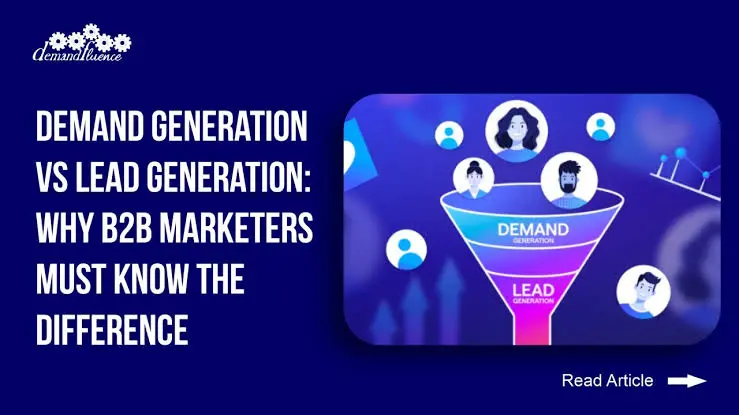
For years, lead generation has been one of the most closely watched metrics in B2B marketing. Marketing teams have celebrated growing databases, increasing form submissions, and generating more marketing-qualified leads. But as buying journeys become longer, buying committees become larger, and buyers conduct more research independently, simply generating more leads is no longer enough.
A contact in a database does not automatically represent a sales opportunity.
Modern B2B organizations are increasingly asking a more important question: How much qualified pipeline is marketing helping create?
That shift is moving the industry from a volume-focused approach toward pipeline generation, where marketing and sales work together to identify valuable accounts, recognize buying intent, engage relevant stakeholders, and create measurable opportunities.
The Problem With Measuring Success by Lead Volume
Lead generation remains an important part of B2B marketing, but lead volume can sometimes create a misleading picture of campaign performance.
A campaign may generate thousands of contacts while producing very few qualified opportunities. Some prospects may have downloaded content simply for research. Others may not have the right budget, authority, business need, or purchasing timeline.
This creates a familiar challenge for revenue teams: marketing reports strong lead numbers, while sales struggles to convert those leads into meaningful opportunities.
The issue is not necessarily poor marketing execution. It is often the result of measuring the wrong outcome.
A growing number of B2B organizations are therefore moving toward metrics that connect marketing activity with revenue outcomes.
Pipeline Generation Changes the Conversation
Pipeline generation focuses on creating qualified opportunities that have a realistic potential to contribute to revenue.
Instead of asking how many leads a campaign produced, organizations can evaluate how many target accounts engaged, how many qualified opportunities were created, how quickly those opportunities progressed, and how much potential revenue entered the pipeline.
This approach creates stronger alignment between marketing and sales.
Marketing becomes responsible not only for attracting attention but also for identifying accounts that demonstrate meaningful interest. Sales, meanwhile, receives greater context around prospect behavior and intent.
The result is a shared focus on revenue rather than departmental activity.
Pipeline Generation vs Lead Generation: Understanding the Difference
The distinction between Pipeline Generation vs Lead Generation becomes clearer when looking at the buyer journey.
Lead generation primarily focuses on attracting and capturing potential prospects.
Pipeline generation takes a broader approach. It considers account fit, buying intent, engagement, stakeholder participation, sales qualification, and opportunity progression.
Lead generation asks:
“Who can we attract?”
Pipeline generation asks:
“Which accounts are most likely to become valuable customers, and how can we help them move toward a purchase?”
Neither approach is inherently unnecessary. Lead generation feeds the top of the funnel, while pipeline generation connects qualified demand with revenue opportunities.
The key change is that B2B organizations are becoming more focused on what happens after a lead is captured.
Buyers Are Doing More Research Before Speaking With Sales
Modern B2B buyers have greater access to information than ever before.
They can compare vendors, read customer reviews, watch product demonstrations, download research reports, attend webinars, explore pricing information, and consult industry communities before contacting a sales representative.
This means traditional lead capture often provides only a limited view of buyer readiness.
A prospect may download a whitepaper today but not be ready to purchase for six months.
Another prospect may visit a pricing page several times, attend a product webinar, explore technical documentation, and engage with multiple pieces of content within a few days.
Both may become leads, but their levels of intent are very different.
Pipeline-focused organizations recognize this distinction.
Intent Data Is Making Pipeline Prioritization Smarter
Buyer intent has become increasingly important as businesses look for better ways to identify accounts that are actively researching solutions.
Intent signals can include repeated website visits, content engagement, product comparisons, webinar attendance, research activity, technology changes, and other behavioral indicators.
When these signals are combined with firmographic and historical customer data, marketing teams can build a clearer picture of which accounts deserve attention.
This helps organizations prioritize their resources rather than treating every lead equally.
AI Is Shaping Predictive Lead Scoring
Artificial intelligence is playing an increasingly important role in this transition.
AI Is Shaping Predictive Lead Scoring by allowing organizations to evaluate far more data points than traditional rules-based scoring systems can handle.
Conventional lead scoring might assign points based on job title, company size, email engagement, or a content download.
Predictive models can analyze broader patterns across CRM records, website behavior, campaign engagement, account characteristics, historical conversions, and other signals to identify prospects that resemble previously successful customers.
This does not eliminate the need for human judgment. Instead, it gives sales and marketing teams better intelligence for deciding where to focus their attention.
Account-Based Strategies Are Supporting Pipeline Growth
The move toward pipeline generation is also closely connected to the growth of Account-Based Marketing.
ABM shifts the focus from individual leads toward high-value accounts and their buying committees.
Instead of treating one contact as the entire opportunity, organizations can identify multiple stakeholders within a target account and develop coordinated engagement strategies.
For example, an enterprise technology company may need to engage an IT leader, finance executive, procurement team, security specialist, and business stakeholder before a purchase can happen.
Pipeline generation provides the framework for measuring whether those account-level interactions are contributing to opportunity creation and progression.
Personalization Has Become a Pipeline Requirement
Generic messaging is increasingly ineffective in complex B2B markets.
Different stakeholders have different priorities, even when they work for the same organization.
AI and customer intelligence platforms allow marketers to personalize content and messaging based on industry, role, business challenge, previous engagement, and buying stage.
A CFO may respond to financial impact and efficiency metrics, while a technical decision-maker may care more about integration, security, and scalability.
Relevant communication helps buyers find useful information faster and increases the likelihood of meaningful engagement.
Marketing and Sales Need a Shared Definition of Quality
Pipeline generation cannot succeed if marketing and sales use different definitions of a qualified opportunity.
Marketing may consider an engaged account ready for nurturing, while sales may require evidence of a specific business problem, budget, decision authority, and purchase timeline.
A shared qualification framework helps resolve this disconnect.
Teams should agree on the characteristics of high-value accounts, the behavioral signals that indicate intent, the criteria for sales acceptance, and the metrics used to evaluate pipeline contribution.
Regular feedback is equally important because market conditions and buyer behavior continuously change.
Revenue Metrics Are Replacing Vanity Metrics
The shift toward pipeline generation is also changing marketing measurement.
Traffic, impressions, clicks, and lead volume still provide useful information, but they do not tell the complete story.
Modern revenue teams increasingly examine metrics such as:
- Qualified pipeline created
- Pipeline velocity
- Opportunity conversion rate
- Revenue influenced by marketing
- Account engagement
- Sales cycle duration
- Average deal value
- Customer acquisition efficiency
- Pipeline contribution by channel
These measurements help organizations understand which marketing activities are actually supporting business growth.
First-Party Data Is Becoming More Valuable
Privacy changes and the decline of traditional third-party tracking methods have increased the importance of first-party data.
Website activity, CRM information, webinar participation, email engagement, customer interactions, and other consent-based signals can provide valuable insights into buyer behavior.
When this data is accurate and responsibly managed, it creates a stronger foundation for segmentation, personalization, intent analysis, and predictive modeling.
The quality of pipeline intelligence ultimately depends on the quality of the data behind it.
The Shift Is About Quality, Not Abandoning Leads
It would be inaccurate to suggest that B2B companies are abandoning lead generation altogether.
Leads remain an essential input into the demand generation process.
The difference is that organizations are becoming more disciplined about what happens after lead capture.
Instead of celebrating a large database without considering its commercial value, businesses are increasingly focused on whether those contacts represent the right accounts, demonstrate meaningful intent, engage with relevant content, and progress toward revenue.
In other words, lead generation remains part of the engine—but pipeline generation measures whether the engine is actually moving the business forward.
The Future of B2B Growth Is Revenue-Focused
The evolution from lead generation to pipeline generation reflects a broader transformation in B2B marketing.
Buyers are more informed. Buying committees are more complex. Digital interactions are generating enormous volumes of behavioral data. AI is making it possible to analyze those signals and identify opportunities with greater precision.
The organizations that succeed will not necessarily be those generating the largest number of leads. They will be the ones capable of identifying the right accounts, understanding buyer intent, delivering relevant experiences, and creating a clear connection between marketing engagement and revenue.
The future of B2B growth is therefore not about choosing between leads and pipeline. It is about building a system in which lead generation feeds intelligent pipeline generation.
For organizations looking to make this transition, reach out to Acceligize. With expertise in B2B demand generation, account-based marketing, intent intelligence, content syndication, and data-driven audience engagement, Acceligize helps businesses move beyond lead volume to identify high-value opportunities, engage the right buying groups, and build stronger, revenue-focused pipelines.
