
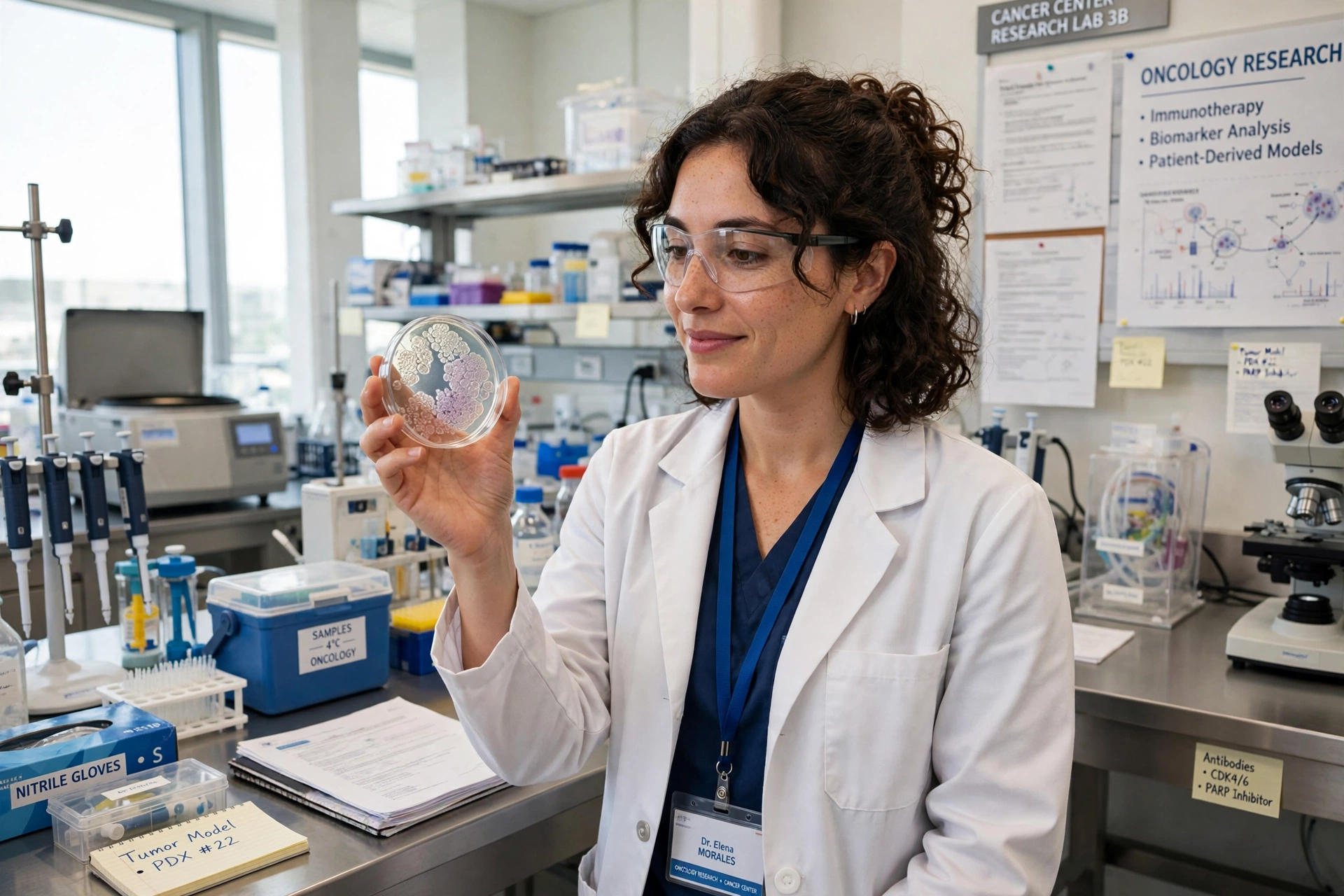
A personalised cancer vaccine called NeoVax has been tested in a small, early trial in people whose ovarian cancer had returned but still responded to platinum-based treatment. The results, published in Nature Medicine, deserve careful reading. This was a phase 1 study, the stage of research designed mainly to test whether a treatment can be made, given safely and tolerated. It was not designed to prove that the vaccine extends life, and nothing in this report should be read as a claim of a cure.
First, what this study was — and what it was not
That caution is not a dismissal. Phase 1 work is where promising ideas either become practical or quietly fail. A vaccine built separately for every patient sounds elegant in a laboratory presentation; the harder question is whether a hospital team can actually sequence a tumour, design the product, manufacture it to standard and deliver it on a clinical timetable. On that practical question, this trial offers genuinely useful early answers.
How a vaccine is built from a patient’s own tumour
NeoVax starts with the mutations found in an individual patient’s tumour. Scientists look for altered protein fragments, known as neoantigens, that appear on cancer cells but not on healthy tissue. A selection of those targets is then built into a personalised vaccine intended to teach the patient’s T cells what to attack. Because every tumour carries a different pattern of mutations, every vaccine in the study was, by design, different from every other.
In this trial the vaccine was combined with nivolumab, a PD-1 immune checkpoint inhibitor already used in several cancers. The reasoning is straightforward: the vaccine tries to raise an immune response against the tumour, while the checkpoint drug removes one of the brakes that can hold that response back. Readers who want the primary record can consult the journal report via Nature Medicine, and a plain-language overview of checkpoint inhibitors is available from the National Cancer Institute.
What the researchers found on safety and immunity
The headline findings were about feasibility and safety. The team reported that vaccines could be manufactured for patients and administered as planned, that the safety profile was acceptable for an early study of this kind, and that immune responses were seen, including T-cell activity directed at vaccine targets. In phase 1 terms, those are the boxes a study hopes to tick: the product can be made, patients can receive it, and the immune system appears to notice.
It is important to keep those findings in proportion. Detecting an immune response in blood tests is not the same as demonstrating that a tumour shrinks, that recurrence is delayed, or that people live longer. Those questions require larger, controlled trials with many more participants and longer follow-up. Our earlier health coverage at this recent article makes the same distinction between an encouraging signal and a proven benefit, and it applies with full force here.
Why ovarian cancer makes this approach interesting
Ovarian cancer that returns after initial treatment remains difficult to manage, and new approaches are badly needed. A personalised vaccine is attractive because it aims at what makes one patient’s cancer distinctive, rather than at a target shared only loosely across patients. In platinum-sensitive recurrent disease, where tumours have already shown some responsiveness to treatment, researchers have a window in which an immune-based strategy can be tested carefully alongside established care.
There are real obstacles. Manufacturing a bespoke product takes time and specialist facilities, which limits how quickly the approach could scale. Costs, quality control and the logistics of sequencing every tumour are unresolved challenges, not footnotes. The study’s contribution is to show that, at least in a small and carefully selected group, the full chain from tumour sample to delivered vaccine can be completed.
What patients should take from the news
If you or someone close to you is being treated for ovarian cancer, the sensible takeaway is measured interest, not a change of plan. This research does not alter standard treatment today, and it does not mean a personalised vaccine is available outside a trial setting. Anyone curious about eligibility for future studies should raise the subject with their own oncology team, who can judge it against their individual history and current evidence.
Larger studies will now need to test whether the immune responses seen here translate into clinical benefit, and in which patients. Until those results exist, the accurate summary is a short one: NeoVax plus nivolumab could be made and given, safety was acceptable in this early setting, and T-cell responses were observed. That is a solid first step, honestly reported — and, for now, it is all the science supports.
