
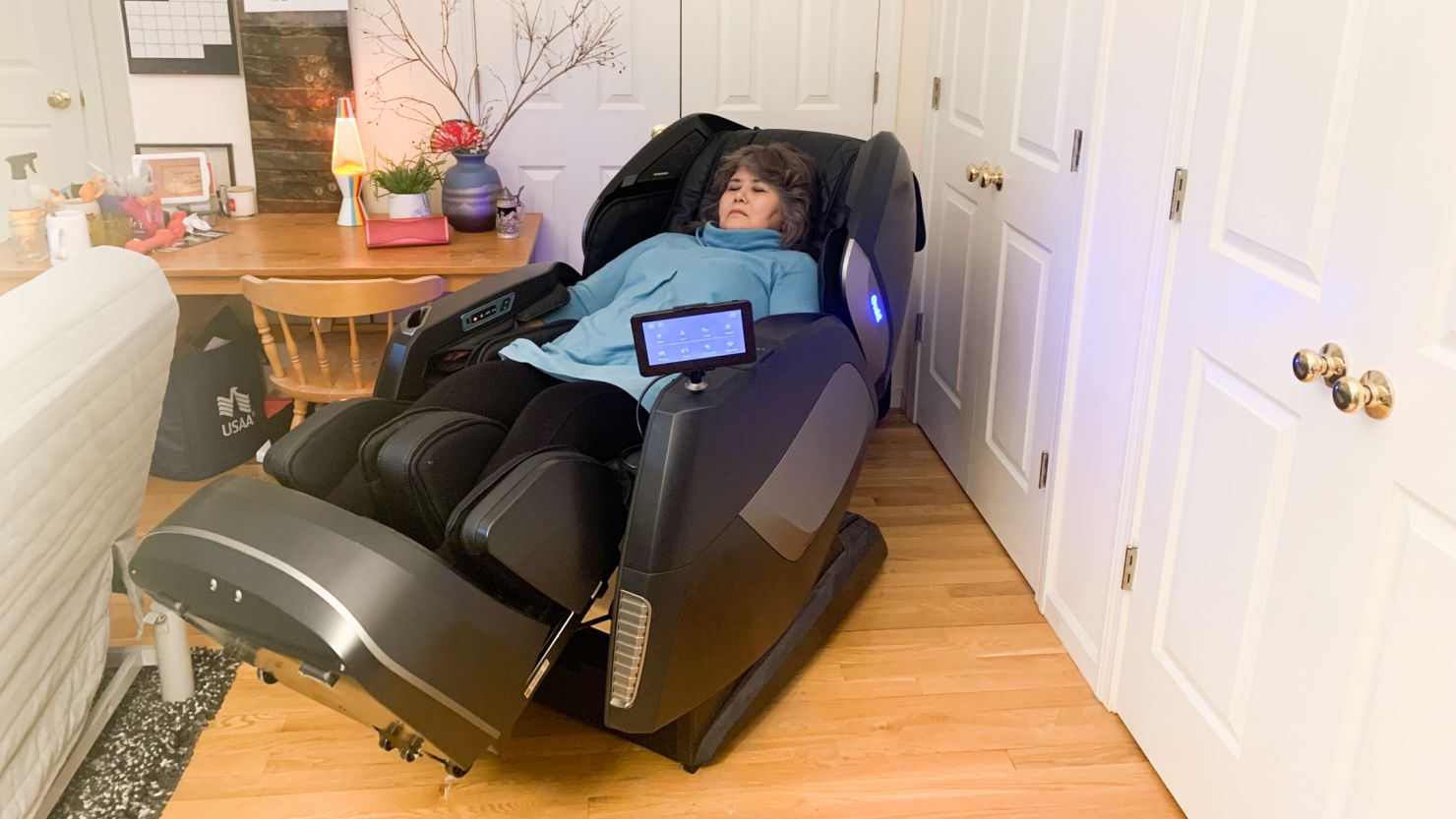
Twelve hours in a pressurised cabin leaves a particular kind of stiffness. Ankles feel a size too big. The lower back has set into the shape of the seat. The shoulders have migrated somewhere up near the ears and show no interest in coming down. Most travellers deal with this by walking it off, or by dropping into one of the massage chairs that now fill airport concourses and hotel lobbies. The chair helps for about twenty minutes. Then the stiffness comes back.
There is a reason for that, and it has less to do with the quality of the chair than with what the body actually needs after half a day of sitting still.
What a long flight does to you
Three things happen at once, and only one of them is muscular.
The first is fluid. When you sit without using your calves, the muscle pump that normally pushes venous blood back toward the heart stops working. Fluid settles in the lower legs and feet. The mild swelling you notice when your shoes feel tight is not imaginary and it does not resolve on its own as quickly as people expect.
The second is dehydration. Cabin humidity sits far below what you are used to on the ground. You lose water steadily through breathing alone, and the fluid that moves through connective tissue becomes thicker and slower.
The third is positional. Fascia, the continuous sheet of connective tissue that wraps and separates muscle, adapts to whatever position you hold it in. Hold a seated shape for twelve hours and the hip flexors shorten, the chest closes, and the whole front line of the body ends up measurably tighter than the back line everyone complains about.
That last point matters, because it explains why the chair disappoints.
What a chair can and cannot reach
A massage chair applies pressure along a fixed track. Rollers travel up and down the spine and sometimes the backs of the thighs, following a programmed pattern, at a depth you choose from three or four presets. For a tired back it is genuinely pleasant.
But it is working on the wrong surface. You have just spent twelve hours compressing the front of your hips and the chair cannot get anywhere near them. It cannot work the calf and ankle where the fluid actually is. It cannot vary its pressure based on what it finds, because it finds nothing — it has no way of knowing that your right shoulder is locked and your left one is fine.
There is also a mechanical difference that rarely gets mentioned. A roller pushes straight down, perpendicular to the body. Manual work uses shear and glide: tissue moved across tissue, in a direction, at a speed. That lateral movement is what encourages fluid to shift, and
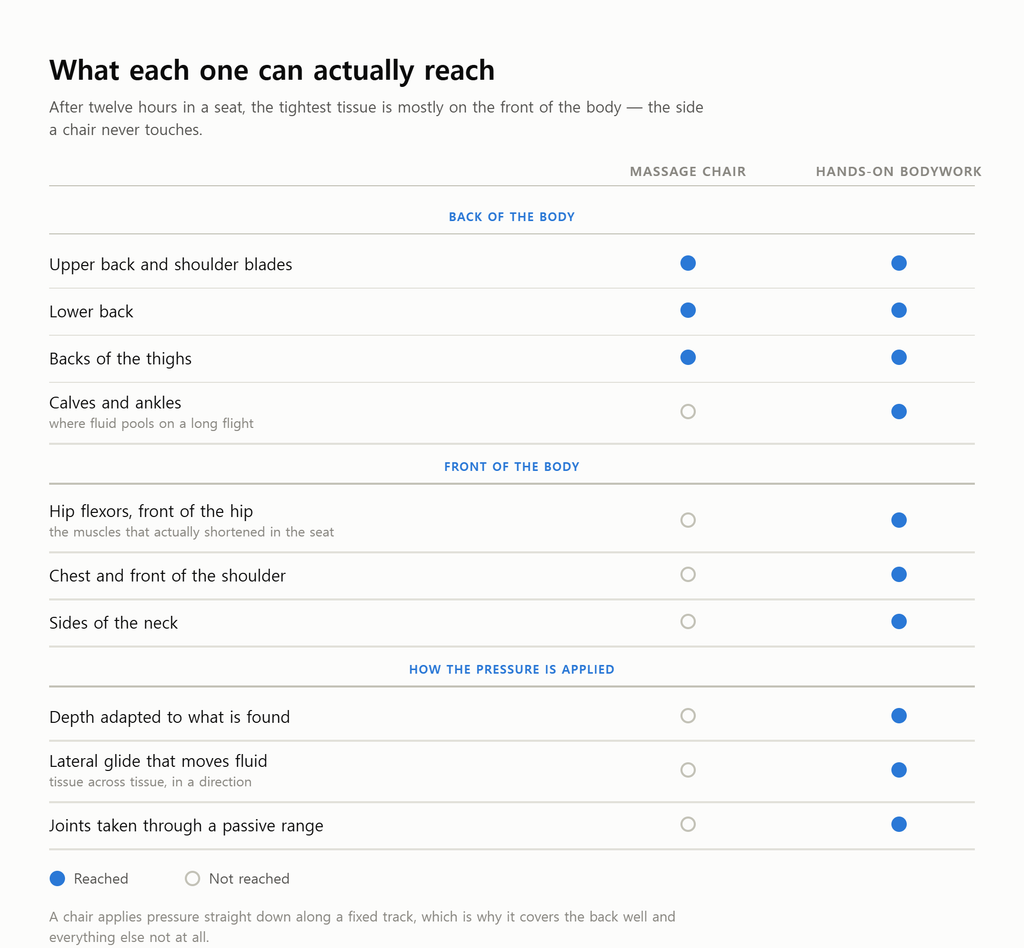
A chair applies pressure straight down along a fixed track, which is why it covers the back well and almost nothing else.
What hands do instead
A therapist reads what they find and changes what they are doing in response. That alone separates the two experiences, but there are four specific things worth paying for after a flight.
Sustained pressure. Connective tissue responds to slow, held contact rather than repetitive stroking. Thirty seconds in one spot often does more than five minutes of movement across it.
Direction. Strokes worked toward the trunk rather than away from it help move the fluid that has pooled in your lower legs. A chair has no concept of direction.
Passive movement. Someone else rotating your hip or extending your shoulder takes the joint through a range you will not reach yourself while your muscles are guarding.
The front of the body. Chest, hip flexors, the sides of the neck. These are the areas that actually shortened on the plane, and they are the areas nothing automated will ever touch.
If you have never booked anything beyond the hotel chair
A few practical notes. Say what you want at the start — pressure level, which areas to spend time on, which to leave alone. Most people say nothing and then spend an hour quietly wishing the therapist would move on. Drink water before and after. And give it at least sixty minutes; forty is enough for one stubborn area, not for a body that has been folded into a seat since yesterday.
Read the menu before you book, too. The word “massage” covers an enormous range, and in Asia it covers more than most visitors assume. Traditional Thai work is clothed, dry and heavily focused on stretching. Oil and aroma treatments are a different thing again. Specialist studios offer services that are different again from both — what a nuru massage actually involves, for instance, has very little in common with the Thai stretching you may have had at home. None of this is hidden information, but nobody explains it to you at the door, and the price difference between categories is substantial.
Where this is easiest to act on
Bangkok is where a large share of long-haul travellers land, and it is also where hands-on work is cheapest relative to quality anywhere in the world. A traditional Thai hour at a neighbourhood shop runs a few hundred baht. A hotel spa will ask ten times that for something milder. Between the two sits a layer of independent studios, most of them clustered along the Sukhumvit corridor within walking distance of the Skytrain, charging somewhere in the low thousands of baht for sixty to ninety minutes with a properly trained therapist.
If you want to see what that middle tier looks like before you arrive, studios like immersemassage.com on Sukhumvit Soi 8 publish a fixed menu with durations and prices rather than quoting at the door, which makes it easy to compare against the spa rate your hotel will quote you. The national tourism board also lists licensed operators by district if you would rather start from an official source.
One last piece of advice, and it is the one most people get wrong: book it for your arrival evening, not for day two. The stiffness is at its worst in the first eighteen hours, and clearing it then is the difference between losing one day to jet lag and losing three.
